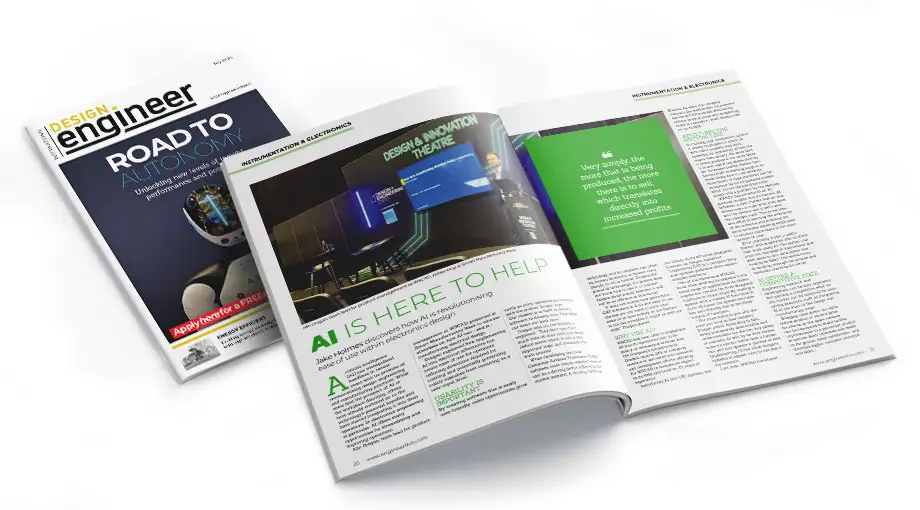
Technical article in the „International Design Engineer“ magazine – July, 30th 2025
Author: Jake Holmes
AI is here to help
Artificial intelligence (AI) has monopolised headlines in recent years with its promise of revolutionising design, engineering and manufacturing practices. While some find the prospect of AI in the workplace daunting, others have already cottoned on to the technology’s potential benefits and have started integrating it into their operations. In electronics engineering in particular, AI offers many opportunities for streamlining and improving operations.
Alin Dragan, team lead for product management at WSCAD, presented at Smart Manufacturing Week to educate attendees on how AI can – and is – transforming electrical design.
Dragan explained how implementing AI into electrical schematics can create ease of use for operators, reducing downtime required for training and potentially preventing costly mistakes from occurring on a user-input level.
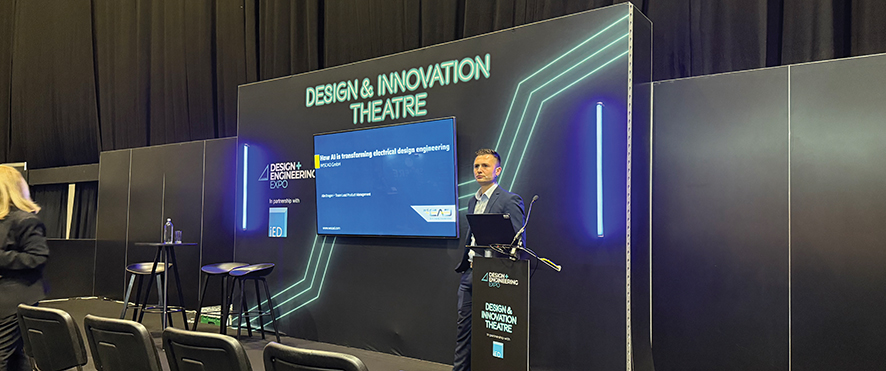
Alin Dragan, team lead for product management at WSCAD, presenting ELECTRIX AI at Smart Manufacturing Week
Usability is important
By creating software that is easily user-friendly, sales opportunities grow vastly as more customers are satisfied with the product. Dragan says: “Our mission is to build, to develop software, to develop tools. That helps our users win back time.”
Dragan lays out the benefits to engineers: “They don’t spend too much time on their electrical design, reduce stress, which is also a very important topic, and obviously also work smarter.”
When developing electrical CAD software, most clients selected ‘ease of use’ as a driving factor, reflecting the market demand. A limiting factor to technology and its adoption can often be human limitation or human error. Simply, to err is human. Despite the power of technology, if a person does not know how to use it, or instead forgets about inbuilt features, it will not be as efficient or functional.
“It does not matter how powerful a CAD software is, if it’s not easy to use the feature you need to solve your issue or to save money, or the feature is not discoverable, it might as well not exist,” Dragan stated.
Why use AI?
WSCAD has been able to implement AI into its operations due to its policy of reinvesting revenue into the company’s infrastructure. Dragan reports 24% of company revenue is reinvested into research and development efforts, allowing for WSCAD to become an expert in its field and build on 35 years of experience.
Introducing AI into CAD systems will not simply make all issues disappear, however, as Dragan explained: “Engineering CAD is a complex thing, and complex problems often require complex solutions.”
One of the limitations WSCAD faces when creating its systems is the broad range of applications its clients require the systems for, from doughnut machines to rocket ships. By making a system with a variety of functions to cover all bases, the system becomes less user-friendly due to the sheer volume of functions.
“The more features you add, the more you tend to lose usability,” Dragan added. According to him, being immediately discoverable and understandable are the two key pillars of usability. AI will, by its very nature, know its system better than a human can, and can operate it quicker as well. Implementing AI can allow complex systems to appear easy to use due to the interface.
Last year, WSCAD introduced ELECTRIX AI, what the company claims is the world’s first AI-powered electrical CAD solution, eliminating tedious manual steps and completing tasks in seconds to slash design time by up to 99%.
Affecting the bottom line
By making task completion quicker, it allows employees to crack on with other projects they have, speeding up operations across the board. Very simply, the more that is being produced, the more there is to sell, which translates directly into increased profits. Rather than having staff contacting support, or researching how to use software, those hours of unproductivity can be minimised by an AI-powered system which knows the solutions when posed with a problem by the operator.
WASCD has introduced an AI-powered co-pilot into its Electrix AI software, a new chatbot feature that allows users to type what they want into the system, and it will make the changes itself. This saves time and effort in learning the intricacies of the software and achieves the same outcome, allowing employees to conduct more tasks in the same amount of time.
Error checking is also a useful feature, with employees able to check their work using AI. The system can point out any gaps in information and alert users to any data points that need to be filled. This saves hours of scrolling through documents and manually checking for errors.
Very simply, the more that is being produced, the more there is to sell, which translates directly into increased profits
Alin Dragan
AI offers a competitive edge
Engineering, research and development can be very expensive. But gaining a competitive edge on the market can be achieved by cost-saving practices, such as integrating AI at the start of the design and manufacturing stage.
Bringing costs down can either reduce product or service price for clients, or the spare revenue can be reinvested to make further improvements to a particular product or service. Both outcomes can result in far greater client satisfaction and therefore higher customer retention and sales.
This technical article is intended exclusively for your personal use. Any reproduction or publication requires the publisher’s explicit written consent.