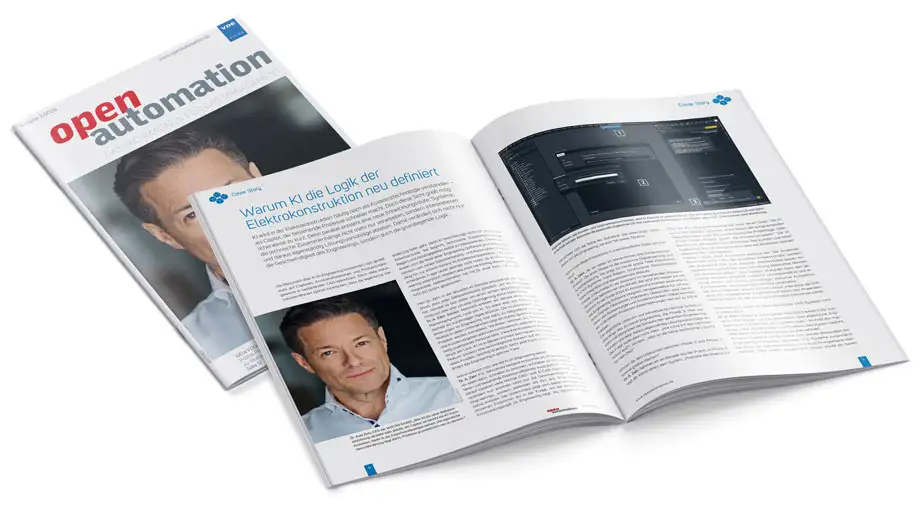
Editorial analysis based on Dr Axel Zein’s interview on the CSIA podcast Talking Industrial Automation, hosted by Lisa Richter. Dr. Zein is CEO and President of WSCAD GmbH, the developer of ELECTRIX AI – the world’s first AI-powered electrical CAD platform – and a former IBM executive.
Electrical engineering is entering a new phase. Not because engineers suddenly need another chatbot, but because the underlying logic of how electrical design gets done – schematics, documentation, cabinet layout, requirements validation, knowledge transfer – is starting to change at its foundation.
That is the core argument from Dr Axel Zein, CEO and President of WSCAD, speaking on the “Talking Industrial Automation” podcast, produced by CSIA, the global trade association for control system integrators in industrial automation. Zein brings a specific perspective to this conversation: his background includes enterprise technology at IBM, and since 2023 he has been leading WSCAD through its own internal AI transformation – not just building AI-powered electrical CAD software, but running an engineering organisation that had to learn how to use it. WSCAD became the first electrical CAD vendor in the world to ship an AI-powered system in production, in 2024.
When Zein talks about what AI-native electrical engineering actually requires, he is drawing on three years of building it, selling it, and watching what happens inside the organisations that try to adopt it.



On This Page
- AI is not just a faster interface
- What AI-native engineering actually means
- Which workflows will change first
- Will AI replace electrical engineers?
- Why industrial companies are hitting a structural limit
- What system integrators should take from this
- Why the real barrier is leadership, not software
- AI is not the advantage – this is
- Realistic expectations: productivity, not magic
- The compounding cost of waiting
- FAQ: Questions engineers are already asking
- Further reading

Dr Axel Zein, CEO of WSCAD: “The future of engineering does not lie in isolated AI assistants, but in AI-Native Engineering – where AI becomes an integral part of the engineering process and the CAD system increasingly turns into the execution and documentation layer.”
AI Is Not Just a Faster Interface
“The biggest misconception is that AI is primarily about chatbots and productivity assistance,” Zein says. “Most companies still approach AI as an add-on. They basically add a chatbot to a 25-year-old workflow and then declare the AI revolution complete.”
The problem with that approach is not that chatbots are useless. The problem is that it leaves the underlying workflow untouched. For decades, electrical engineers have conceptualised solutions in their heads, then manually transferred that thinking into schematics, device tags, cross-references, terminal plans, bills of materials, and cabinet layouts. That sequence – mental model to manual documentation – has been left untouched for decades. The real question AI forces onto the table is not how to accelerate those steps, but whether they need to exist at all in their current form. As Zein puts it: “The real opportunity is not in helping engineers draw faster. The real opportunity is fundamentally changing how engineering itself is created.”
The real opportunity is not in helping engineers draw faster. The real opportunity is fundamentally changing how engineering itself is created.
For more context on this shift, WSCAD’s article Why AI is redefining the logic of electrical design maps out the transition from AI-assisted to AI-native engineering in three phases.
What “AI-Native Engineering” Actually Means
Industry vocabulary absorbs new terms before they are properly defined – which is exactly how “AI-native” risks becoming the next “digital transformation”: ubiquitous and meaningless. Zein’s definition is specific enough to avoid that.
In the traditional model, a CAD user draws. They externalise a mental model into documentation – one symbol, one connection, one wire annotation at a time. Even the most sophisticated modern electrical CAD platforms follow this logic: the engineer defines every detail; the system renders it. Drawing faster is the only optimisation available within this model.
AI-native engineering changes the architecture. Instead of manually specifying every detail, the engineer defines intent, constraints, requirements, and objectives. The AI system generates and orchestrates large portions of the engineering process from those inputs. In Zein’s formulation, CAD as traditionally known will probably become the execution layer, while AI becomes the decision layer – and that architectural shift is precisely what WSCAD means by AI-native engineering.
| Traditional electrical CAD | AI-Native electrical CAD | |
|---|---|---|
| Engineer’s input | Every schematic detail | Intent, constraints, requirements |
| System’s role | Renders what the engineer draws | Generates and orchestrates |
| Value creation | Drawing speed and accuracy | Requirements intelligence, decision-making |
| CAD’s role | Primary workspace | Execution and documentation layer |
“CAD, as we traditionally know it today, will probably become the execution layer, while AI becomes the decision layer,” Zein explains. “And that’s what we mean by AI-native engineering.”
Engineering value shifts upstream – from drafting fidelity toward the judgement calls that AI cannot and should not make autonomously. This is not, Zein emphasises, an incremental software update. “We are not talking about a chat window inside a CAD system,” he says. “We are talking about a new engineering paradigm.”
We are not talking about a chat window inside a CAD system. We are talking about a new engineering paradigm.
Further reading: AI Native Engineering is more than just another Copilot
Which Electrical Engineering Workflows Will AI Transform First?
Zein is specific about where the impact lands first: the repetitive, documentation-heavy tasks that consume a disproportionate share of engineering time without requiring the judgement that defines the profession. Every electrical project, without exception, involves the same recurring overhead:
- Generating bills of materials from schematic data
- Creating terminal diagrams and terminal plans
- Interpreting requirements from customers or upstream departments
- Cross-referencing components and managing numbering schemes
- Validation passes and error checking across documentation sets
- Propagating design changes consistently across an entire project
“Engineering today is still highly sophisticated copy-paste management,” he says. “Many engineers spend enormous amounts of time not actually engineering, but managing complexity.” A discipline that demands years of training has evolved, in many organisations, into a system for managing the bureaucratic overhead that the engineering process itself generates.
Engineering today is still highly sophisticated copy-paste management. Many engineers spend enormous amounts of time not actually engineering, but managing complexity.
WSCAD’s 2024 global survey of 1,267 electrical engineers across 40 countries puts a number to this: 54% reported they do not have time for innovation. They are too focused on delivering projects on time and on budget. That is not a workforce motivation problem. It is a structural capacity problem – and AI is, in Zein’s view, the only credible path to solving it. The goal, he says, is workflows that become “more automated, more system-driven, and much more knowledge-centric – not so much about me having to perform a specific function in the system.”
Practical reference: How to use the ELECTRIX AI Copilot – how text commands trigger real engineering actions in ELECTRIX AI.
Will AI Replace Electrical Engineers?
It is the question in every room when the topic of AI comes up. Zein answers it directly: no, electrical engineers will not disappear. But the role will change more significantly than most people currently expect.
Every major technological leap, he argues, changed the role of the people involved rather than eliminating them. “Probably future engineers will look back at some of the current workflows the way we look at manually drafting with ink pens,” Zein says. The directional shift is clear: less time drawing, more time deciding – defining systems, validating outcomes, orchestrating automation. The engineer’s authority over technical decisions does not diminish. The mechanics of producing documentation stop consuming it.
Zein uses a concrete historical analogy to illustrate the point. The transition from horse carriage to railway did not primarily eliminate coachmen – it replaced a job with an ecosystem. Most individual coachmen did not make a clean transition to train conductor. But one train created more roles than a single coach ever could, and society ended up with far more trains than it ever had coaches. Job expansion followed displacement, at a scale the previous model could never have reached. He sees the same pattern ahead for electrical engineering. The work that will disappear first, he notes, is also the work most engineers find least satisfying. “Some of the work nobody’s enjoying doing late evenings before a deadline will probably disappear,” Zein says. “Which is good. I think engineers will not disappear. I think they will, in fact, be upgraded.”
Some of the work nobody’s enjoying doing late evenings before a deadline will probably disappear. Which is good.
Why Industrial Companies Are Reaching a Structural Limit
The urgency behind AI adoption in electrical engineering is not driven by technology curiosity. It is driven by a convergence of operational pressures that are making the traditional engineering model increasingly difficult to sustain.
Zein maps them out: industrial customers want more customisation per project. Delivery timelines are compressing. Documentation and compliance requirements are growing – and with everything becoming more interconnected (machine software, cybersecurity, regulatory compliance), the overhead on each project increases further. Meanwhile, the engineering talent base is contracting as experienced professionals retire. The result is a structural mismatch: more complexity per project, fewer engineers to handle it, and shrinking time to deliver.
“Many companies are reaching a structural limit with traditional engineering approaches,” Zein says. “That’s why AI is becoming strategically important. Not because it’s fashionable – and yes, it is fashionable – but because the current engineering workflow is under pressure and difficult to scale.”
The 54% finding from WSCAD’s survey is worth returning to here: when more than half of the engineering workforce has no bandwidth for innovation, the problem is not individual productivity. The problem is that the model itself has hit a ceiling. AI, in that context, is not a nice-to-have. It is structural relief.
System integrators are often closest to the actual operational realities inside industrial companies. We believe AI adoption in industrial automation will happen through practical implementation – not theoretical discussions.
What System Integrators Should Take From This
Zein gives system integrators a specific message: they are in a structurally strong position, because they sit closer to real operational problems than almost anyone else in the industrial ecosystem.
The challenge for SIs is familiar: margins are under pressure while project complexity continues to rise. AI addresses that squeeze directly – faster engineering throughput, faster documentation, fewer repetitive tasks, better knowledge reuse across projects. As a force multiplier for exactly the kind of engineering-heavy work that defines SI projects, the value proposition is concrete. But Zein makes a distinction that matters: the winners will not be the companies with the most AI tools. “It’s not necessarily the companies with the vast AI tools that are going to win,” he says. “I think the winners will be companies that integrate AI into updated engineering workflows.” The tool is not the advantage. The integration is.
WSCAD’s own involvement with CSIA reflects this view directly. “System integrators are often closest to the actual operational realities inside industrial companies,” Zein explains. “We believe AI adoption in industrial automation will happen through practical implementation – not theoretical discussions.” CSIA, he adds, brings together the organisations that are actively building the future of industrial systems – making it, in his words, “a very valuable ecosystem.”
System integrators are often closest to the actual operational realities inside industrial companies. We believe AI adoption in industrial automation will happen through practical implementation – not theoretical discussions.
Why the Real Barrier Is Leadership, Not Software
Three years into WSCAD’s own AI transformation, Zein is candid about what turned out to be harder than the technology. The technical barrier, he says, was smaller than most people expect. “CPUs and GPUs are sometimes less stubborn than organisations.”
WSCAD began building internal AI competence in early 2023, shortly after the initial GPT release in late 2022. What followed was a pattern most organisations will recognise: tension between people eager to move forward and those defending established methods. Zein acknowledges both instincts exist in most people simultaneously – the pull of the comfort zone on one side, genuine curiosity on the other. The deeper challenge was organisational behaviour: “The willingness to experiment, the tolerance for change, the speed of decision-making, and whether leadership actually creates an environment where people can adapt,” as he puts it.
The framing that consistently fails is treating AI as an IT rollout. Organisations that approach it as the next software deployment project miss what the transformation actually demands – rethinking workflows, responsibilities, engineering processes, and sometimes business models themselves. “If you treat AI as an IT topic – ‘it’s the next tool we’re introducing’ – that’s a fundamental misread,” Zein says. “It’s an operational transformation topic.”
Successful AI adopters, in Zein’s observation, share several traits:
- Leadership that actively supports experimentation
- Decision-making that moves faster than the technology itself
- Tolerance for process change, including the discomfort that comes with it
- Willingness to rethink responsibilities and workflows – not just add new tools to old ones
- Organisational learning built through early adoption rather than delayed observation
Zein is equally direct about the remedy: the cultural shift that genuine AI adoption demands takes time to build – and that is exactly why starting early matters. “This cultural shift matters enormously because it takes time,” he says. “Starting early pays off.”
If you treat AI as an IT topic – ‘it’s the next tool we’re introducing’ – that’s a fundamental misread. It’s an operational transformation topic.
AI Is Not the Advantage – This Is
As AI capabilities become commoditised – available to any organisation willing to pay for access – the question of what actually creates durable competitive advantage becomes more important.
Zein’s answer cuts against the intuitive assumption that having AI is the goal. The real advantage, he argues, is not using AI but how effectively a company can apply it within its specific domain. In electrical engineering, domain expertise is not a soft advantage. It is a hard constraint. The field operates within a dense framework of industry standards, safety regulations, and engineering norms that an AI system must understand and respect to be useful rather than dangerous. Generic AI cannot navigate those constraints without domain-specific training and integration. That gap between having AI and operationalizing it productively in a technically constrained environment is where the actual competitive distance gets created. “The winners won’t simply have AI,” Zein says. “They will understand workflows, customer pain points, industrial requirements, and how to operationalise AI safely and productively. And that takes time – and that’s much harder than just adding a chatbot to your support.”
The winners won’t simply have AI. They will understand workflows, customer pain points, industrial requirements, and how to operationalise AI safely and productively.
The implication for companies evaluating their AI posture: the relevant question is not “do we have AI tools?” It is “how deeply have we integrated AI into the specific workflows where our domain expertise creates value?”
Realistic Expectations: Productivity, Not Magic
Zein earns credibility by refusing to oversell. “Companies can expect productivity improvements, but not magic,” he says plainly.
He identifies a pattern that plays out repeatedly across technology adoption cycles: organisations treat AI as a box labelled with all the problems they have not solved, apply the technology, and discover the underlying problems are still there – now running faster. “Bad processes with AI are still bad processes.” The technology does not fix the process; it amplifies whatever is already there.
The sequence that actually works is the opposite of what most organisations attempt: clean up workflows first, structure engineering knowledge, standardise processes – then embrace AI pragmatically within that foundation. Done in that order, the gains are real: faster project delivery, more consistent documentation, lower error rates, and the ability to scale engineering output without proportionally scaling headcount. Zein summarises the potential plainly: “It’s not a replacement for operational excellence. Companies that clean up workflows, structure knowledge, standardise on new processes, and embrace AI pragmatically can absolutely achieve major gains in speed, quality, consistency – and most of all, scalability,” he says. “AI is really a segue to scale.”
Bad processes with AI are still bad processes. AI is not a replacement for operational excellence – it is a segue to scale.
The Compounding Cost of Waiting
The final thread in Zein’s argument is about timing – and it is the most strategically important one for organisations that default to a “let’s wait and see” posture.
The gap between early AI adopters and late movers, five years from now, will not primarily be a technology gap. It will be an organisational learning gap. Organisational learning cannot be acquired retrospectively – it compounds forward, or it does not compound at all. Companies adopting AI early are building internal know-how, operational experience, and cultural adaptability right now. “And that’s not just a fancy word,” Zein says. “That’s actually hugely important.” The engineering team that has spent three years integrating AI into real workflows has built something its competitors cannot simply license.
The most dangerous posture, in Zein’s view, is the one that feels like prudence. “The most dangerous sentence today would be: ‘Let’s wait a few years and see what happens with AI,'” he says. “Because that compounds over time.”
The most dangerous sentence today would be: ‘Let’s wait a few years and see what happens with AI.’ Because that compounds over time.
“The biggest difference will be between companies that learned how to evolve while others waited for certainty. And historically, certainty usually arrives too late.”
Asked what advice he would give to a younger version of himself, Zein does not reach for a strategy framework. The answer is the same principle applied personally: “Be bolder. Dare more. Take bets. Don’t listen too much to possible obstacles and worries that others might see in your way – you’ll face them soon enough anyway. I don’t think anyone has ever regretted trying something and failing. Probably most people regret not having tried early enough.”
Frequently Asked Questions About AI in Electrical Engineering
Will AI replace electrical engineers?
No. According to Dr Axel Zein of WSCAD, AI will remove low-value routine work while increasing the importance of engineering judgement, systems thinking, technical validation, and decision-making. Engineering becomes more conceptual, more interdisciplinary, and more decision-oriented – not redundant. The role evolves; it does not disappear.
What is AI-native engineering in electrical CAD?
A design paradigm in which engineers define intent, constraints, and requirements rather than manually specifying every schematic detail. The AI system generates and orchestrates large portions of the engineering process from those inputs. CAD software becomes the execution layer; AI becomes the decision layer. It is not a chat window inside a CAD system – it is a different architecture for how engineering decisions get made and documented.
Which tasks in electrical engineering are most suitable for AI automation?
Bill of materials generation, terminal diagram creation, requirements interpretation, cross-referencing and numbering, design change propagation, and validation and error checking. These documentation-heavy, repetitive tasks consume significant engineering capacity on every project without requiring the domain judgement that defines the profession.
What is the biggest mistake companies make when adopting AI in engineering?
Adding AI to existing, unreformed workflows without addressing the underlying process and cultural issues. Zein calls this “adding a chatbot to a 25-year-old workflow and declaring the AI revolution complete.” AI amplifies what is already there: efficient processes become more scalable; broken processes become more consistently broken. Workflow restructuring must precede AI adoption, not follow it.
Why are companies under pressure to change now?
Because engineering complexity is rising while experienced specialists are retiring, customisation demands are increasing, delivery timelines are compressing, and compliance requirements – including machine software integration and cybersecurity – continue to expand. 54% of 1,267 engineers surveyed across 40 countries reported no time for innovation – only project delivery. That is a structural problem, not a motivation problem.
What separates successful AI adopters from struggling ones?
Leadership and culture, not access to tools. Successful adopters share faster decision-making, tolerance for process change, willingness to rethink workflows and responsibilities, and organisational learning built through early adoption. Companies that treat AI as an IT deployment project consistently underestimate the time and cultural effort required.
When should electrical engineering teams start adopting AI?
Now – because the gap between early adopters and late movers in five years will not be a technology gap. It will be an organisational learning gap. Internal know-how, cultural adaptability, and operational experience take years to build and cannot be acquired retrospectively.
Further Reading
- Why AI is redefining the logic of electrical design
- AI Native Engineering is more than just another Copilot
- ELECTRIX AI – the world’s first AI-powered electrical CAD
- ELECTRIX AI: Artificial intelligence as a productivity game changer
- How to use the ELECTRIX AI Copilot
- AI turns circuit diagrams into control cabinet designs in seconds
- How AI is restructuring control cabinet engineering
Source: CSIA Talking Industrial Automation podcast – “The Future of Engineering: Why AI-Native Workflows Will Change Everything with Dr Axel Zein.” WSCAD GmbH is the developer of ELECTRIX AI, the world’s first AI-native electrical CAD platform, serving more than 40,000 engineers across 80+ countries. Survey data: 1,267 electrical engineers, 40 countries, 2024.