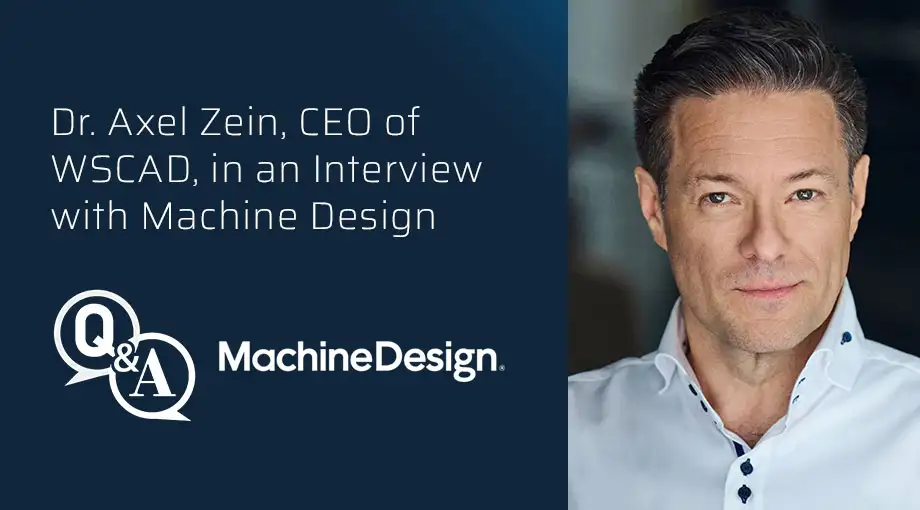
This article is based on an interview with Dr Axel Zein, CEO of WSCAD GmbH, conducted at ‘Best of Cabinet Building Day 2026’, an online event organised by VDE Verlag GmbH, Berlin.
For more than four decades, electrical engineering software has followed the same basic principle. Engineers develop solutions, make technical decisions and create system concepts. The electrical CAD system then serves as the platform used to design, document and manage those solutions. From paper-based workflows to modern electrical CAD software, the tools have evolved dramatically. Yet one thing has remained unchanged: the engineering intelligence resides almost entirely with the engineer.
For decades, engineering knowledge has existed primarily inside the engineer’s mind. Electrical CAD systems dramatically improved the efficiency of design and documentation processes, but the engineering intelligence itself remained entirely human. Engineers developed solutions, evaluated technical alternatives and made design decisions before documenting the results in the CAD system. According to Dr Axel Zein, CEO of WSCAD, AI Native Engineering challenges this principle for the first time by enabling AI to actively participate in the engineering process itself – rather than merely documenting its outcome.
The question is no longer whether AI will transform engineering, but how quickly – and whether you will be part of it or left behind
Speaking at VDE Best of Cabinet Building Day 2026, Dr Zein outlined why the industry is moving beyond AI assistants and Copilots towards a new approach that WSCAD calls AI Native Engineering.

Dr Axel Zein, CEO of WSCAD GmbH: “The future of engineering does not lie in AI assistants, but in AI Native Engineering, where artificial intelligence becomes an integral part of the engineering process.”
What Is AI Native Engineering?
AI Native Engineering is an engineering paradigm in which artificial intelligence actively participates in the development of engineering solutions. Unlike AI assistants or Copilots that support individual tasks, AI Native Engineering operates within the engineering context itself, helping interpret requirements, evaluate technical relationships and generate engineering proposals before automatically producing the associated documentation.
The Real Bottleneck in Cabinet Engineering Is Not Technology
Engineering departments in cabinet building are under increasing pressure. Projects are growing in complexity, documentation requirements are rising, and delivery schedules are tightening – all while experienced electrical engineers and cabinet designers are becoming harder to find and retain.
A WSCAD study of more than 1,200 electrical engineers across 40 countries revealed a strikingly consistent message: engineering teams are operating at their limits. The study revealed that many engineering teams have little capacity left for innovation, process improvement or future-oriented development. Day-to-day project execution increasingly consumes available resources, leaving organisations struggling to scale despite growing demand. As Dr Zein put it: “Many engineering departments are working at their absolute limit and have virtually no time left for innovation or forward-looking topics.”
The most significant consequence is often overlooked. When engineering teams spend the majority of their time executing repetitive project work, innovation suffers. Many organisations no longer lack ideas – they lack the engineering capacity required to develop and implement them. AI therefore becomes not only a productivity tool, but also a mechanism for restoring innovation capacity.
Many companies underestimate how much time engineers spend on repetitive, recurring tasks.
Those tasks include:
- Searching for and placing components
- Assigning device identification tags
- Checking cross-references
- Generating terminal plans
- Creating bills of materials
- Manually propagating design changes across documentation
These activities are essential to every project. They recur without exception. And they consume a significant share of engineering capacity that could otherwise be applied to system architecture, functional optimisation, safety review, and genuine technical innovation.
Where AI Delivers Measurable Results Today
The greatest productivity gains occur wherever repetitive engineering activities can be automated within a defined technical framework. In cabinet engineering, that means AI can already handle component placement and DIN rail positioning, cable duct layout and routing proposals, cross-reference verification, bill of materials and terminal plan generation, and design consistency checks across the project.
One of the most visible applications is the automatic generation of cabinet layouts directly from electrical schematics. Dr Zein describes the practical impact in concrete terms: “We can now automatically generate cabinet layouts from electrical schematics – including all component placement, DIN rails, cable ducts, and routing – and that reduces tasks that used to take hours to just a few minutes.” The impact is not simply a matter of speed. As Dr Zein notes, “We are not only changing the speed – we are changing the economics of engineering itself.”
Tasks that used to take hours now take minutes – and we are not only changing the speed, we are changing the economics of engineering itself.
Organisations can deliver more projects with the same team, reduce their dependence on individual experts, and begin to address one of the most pressing challenges in the sector: the difficulty of recruiting and retaining experienced cabinet engineers. WAGO reported engineering time savings of 50 % after implementing WSCAD ELECTRIX AI – not a future projection, but a result achieved in practice in 2025.
The Problem with Copilots and Cloud-Based AI
Most AI solutions currently available in the market operate as assistants. They provide suggestions, chat interfaces, or task-specific automation capabilities. These can be useful additions to existing workflows. WSCAD was not only an early adopter of AI in electrical engineering. In 2024, the company became the first provider worldwide to deliver an electrical CAD system with integrated artificial intelligence for productive engineering use. The first ELECTRIX AI release in the year 2024 included Copilot functionality and demonstrated what AI could add to existing engineering workflows. This practical experience with AI-assisted engineering forms the foundation of WSCAD’s current AI Native Engineering approach and provides a unique perspective on the limitations of conventional Copilot-based solutions. That release included Copilot functionality – and it demonstrated what AI could add to existing engineering workflows. But Dr Zein draws a sharp distinction between assistants and AI Native Engineering – and the difference is structural, not cosmetic. As he explains: “Many current solutions add individual AI assistants or Copilot functionality to an existing CAD system. That improves certain workflows. We did exactly that ourselves two years ago. But it does not change the underlying logic of engineering.”
Adding a Copilot to a CAD system improves certain workflows. It does not change the underlying logic of engineering.
The architectural problem runs deeper. Many Copilot implementations operate outside the engineering core: the CAD system runs locally while the AI layer runs in the cloud. In these environments, AI typically analyses engineering data after significant parts of the engineering process have already been completed. While this can support review activities and provide useful recommendations, it limits the ability of AI to contribute during active engineering work – precisely when critical design decisions are being made. Dr Zein states this directly: “If your CAD system is local and your Copilot is in the cloud and they do not communicate with each other, the AI can only analyse information once the development process is already finished. It cannot actively intervene in the live engineering process. That makes the added value quite limited.”
If your CAD system is local and your Copilot is in the cloud and they do not communicate, the AI can only analyse information once the development process is already finished.
This is not a minor technical detail. It determines whether AI can influence engineering outcomes or merely help document decisions that have already been made.
Why AI Native Engineering Represents a New Engineering Paradigm
The transition from paper-based design to CAD transformed how engineering documentation was created. AI Native Engineering goes one step further by transforming how engineering itself is performed.
For the first time, engineering intelligence is no longer limited to the engineer alone. AI can actively participate in interpreting requirements, evaluating technical options and generating engineering proposals. This fundamentally changes the relationship between engineer, software and engineering knowledge.
For this reason, AI Native Engineering should not be viewed as another software feature. It represents the most significant transformation of engineering workflows since the introduction of CAD systems.
What AI Native Engineering Actually Means
AI Native Engineering addresses this limitation directly. Rather than operating alongside engineering as an external tool, AI becomes part of the process itself – embedded within the active engineering context, capable of interpreting requirements, understanding technical relationships, evaluating constraints, and generating engineering solution proposals in real time.
Historically, engineers first developed a solution concept and then used CAD software to translate that concept into schematics, layouts and project documentation. AI Native Engineering introduces a different model. AI becomes part of the development process itself, supporting the creation of technical solutions before automatically generating the corresponding documentation within the CAD environment. Dr Zein describes the shift: “A CAD system as we know it today is used to draw what the engineer has already developed in their head. With AI Native Engineering, the system becomes part of the actual engineering itself – it helps the engineer to develop, and then generates the documentation in the CAD system.”
The CAD system increasingly becomes the execution and documentation layer, while the actual engineering intelligence emerges in an AI layer above it.
This changes what a CAD system fundamentally is and does. Rather than being the primary location where engineering work takes place, it becomes the execution and documentation layer for solutions developed in collaboration between engineer and AI. That is why WSCAD describes AI Native Engineering as a new engineering paradigm rather than another software feature. As Dr Zein puts it: “We are talking about a new engineering paradigm – not a chat window inside a CAD system.”
Keeping AI Within Engineering Rules – and Why That Matters for Quality
A common concern about AI in technical environments is accuracy. In cabinet engineering, schematics, layouts and project documentation must be technically correct, traceable and compliant with applicable standards. One of the key challenges in industrial AI environments is preventing uncontrolled or technically invalid outputs. Unlike consumer AI applications, engineering systems must operate within clearly defined technical boundaries – ensuring that generated results remain traceable, technically plausible and compliant with established engineering standards.
Dr Zein is direct on this point: “You cannot view AI as a replacement for engineering rules. You have to make AI run within defined rules, within defined technical constraints. That way, traceability and control are maintained at all times.”
You cannot view AI as a replacement for engineering rules. You have to make AI run within them.
When AI is constrained by established engineering logic – component compatibility rules, wiring standards, layout conventions – it cannot freely generate technically invalid proposals. The engineer retains full responsibility for validation and approval, but the AI starts every proposal from a technically sound foundation. There is a further benefit: many engineering errors originate not from a lack of expertise but from the cumulative effect of repetitive manual work. As Dr Zein observes, “Forgotten cross-references, inconsistent data – these things simply fall away.” By automating repetitive tasks within a rule-governed framework, AI reduces precisely those error sources that are most common and most difficult to catch through manual review. Automation and quality improvement are not in tension – in practice, they reinforce each other.
Eliminating Friction at the Handover Points
Productivity losses in engineering rarely distribute evenly across a project. They concentrate at the boundaries between systems, departments and information formats. Dr Zein identifies this as one of the most significant opportunities for AI: “The greatest friction losses arise at the transitions between information, systems, and people – for example when bills of materials are inconsistent, or when changes have to be manually transferred, or when information arrives as a Word file or PDF.”
The greatest friction losses arise at the transitions between information, systems, and people
One of the most practically significant applications of AI in this context is the automated conversion of PDF documentation into structured electrical schematics. As Dr Zein explains: “Converting a PDF into a structured schematic is a huge topic. It reduces error sources and saves an enormous amount of time.” Instead of reconstructing information that already exists in another format, engineers can begin with data that is immediately usable within their CAD environment. Project consistency improves, lead times shorten, and the risk of transcription errors falls substantially.
The Evolving Role of the Electrical Engineer
The shift towards AI Native Engineering raises an obvious question about the future of engineering as a profession. Dr Zein’s answer is unambiguous: the role will not diminish. It will evolve.
Over the past decades, engineering expertise was often measured partly by a professional’s ability to operate increasingly sophisticated software systems. AI Native Engineering shifts the emphasis away from software operation and towards engineering judgement, systems thinking and technical decision-making. As Dr Zein explains, future engineers will work differently: “In the future, engineers will increasingly describe what they actually want – the requirements, the constraints, perhaps a few technical details – and the system handles the implementation, makes suggestions that can be modified. But the engineer will work less and less directly inside the CAD system.”
The engineer will be upgraded. The importance of experience, of systems understanding, of technical know-how – that actually increases.
Knowing where to find a function in the software becomes less relevant. Technical judgement, systems understanding and accumulated engineering experience become more valuable. The engineer’s authority over technical decisions does not diminish. Their time is simply no longer consumed by the mechanics of producing documentation.
AI Native Engineering also addresses a growing knowledge-transfer challenge. Many organisations depend heavily on a small number of experienced engineers whose expertise has accumulated over decades. By embedding engineering knowledge, rules and best practices into AI-supported workflows, organisations can make critical expertise more scalable, transferable and resilient.
From Incremental Improvements to Order-of-Magnitude Gains
Most engineering software innovations deliver incremental improvements. AI Native Engineering aims at a fundamentally different scale of impact. While traditional productivity initiatives often achieve gains of 10 to 20 %, AI Native Engineering targets order-of-magnitude improvements by automating entire classes of repetitive engineering activities and enabling engineers to focus on technical decision-making.
Why Waiting Is a Strategic Risk
Many organisations still treat AI as a topic to evaluate in the future. Dr Zein regards this as a strategic error: “Many companies still view AI as a future topic or an interesting demo. I believe that is a strategic mistake.” The reasoning is straightforward. The challenge of integrating AI into engineering processes is not primarily technological. As Dr Zein notes, “The difficulty is not the technology – the difficulty is changing the organisation accordingly.” Adapting processes, workflows and team structures takes time. Organisations that begin now will be operationally ready when AI Native Engineering reaches its full potential. Those that wait will face a steeper transition against competitors who are already producing more with the same resources.
AI Native Engineering is not primarily about automation. It is about scalability, knowledge transfer, engineering capacity and long-term competitiveness. Organisations that begin integrating AI into their engineering processes today are likely to gain significant advantages in productivity and innovation over the coming years. According to Dr Zein, the decisive question is no longer whether AI will transform engineering. The decisive question is how quickly organisations adapt – and whether they actively participate in that transformation.
We are experiencing the biggest technological transformation in engineering since the introduction of CAD systems.
WAGO’s 50 % time saving with ELECTRIX AI represents the current baseline. For AI Native Engineering approaches, Dr Zein’s assessment points considerably further: “With AI Native Engineering, we are talking about a factor of ten.”
With AI Native Engineering, we are not talking about 10 or 20 %. We are talking about a factor of ten.
Frequently Asked Questions About AI Native Engineering
What is AI Native Engineering?
AI Native Engineering is an engineering approach in which artificial intelligence actively participates in the engineering process. Instead of acting as an external assistant, AI helps interpret requirements, understand technical relationships and generate engineering solution proposals within the active engineering environment.
How is AI Native Engineering different from a Copilot?
A Copilot assists with individual tasks and workflows. AI Native Engineering becomes part of the engineering process itself. It contributes to engineering decisions and solution development rather than simply supporting completed work.
Can AI automatically generate cabinet layouts?
Yes. Modern AI-powered engineering systems can automatically generate cabinet layouts from electrical schematics, including component placement, DIN rails, cable ducts and routing proposals.
Can AI convert PDF documentation into electrical schematics?
Yes. One of the most promising applications of AI is the transformation of unstructured PDF documentation into structured engineering data and electrical schematics. This reduces manual effort and improves data consistency.
Will AI replace electrical engineers?
No. AI automates repetitive engineering tasks but does not replace engineering expertise. Engineers remain responsible for requirements, technical decisions, validation, compliance and system architecture.
How does AI improve engineering quality?
AI helps reduce common sources of error such as missing cross-references, inconsistent data, documentation mistakes and incomplete implementation of design changes. By continuously monitoring project consistency, AI can improve both productivity and quality.
Why is AI becoming important in cabinet engineering?
Engineering departments face increasing project complexity, tighter schedules and growing skills shortages. AI helps organisations scale engineering capacity, automate repetitive tasks and improve productivity without compromising quality.