Drives & Controls online article (17 February 2026 )
Four companies – ABB, Phoenix Contact, WSCAD and the enclosure specialist, häwa – have demonstrated what they claim is the world’s control cabinet designed from a digital circuit diagram using AI (artificial intelligence). At the recent SPS show in Germany, they showed WSCAD’s Electrix AI 2026 design software generating a production-ready control cabinet layout automatically from a circuit diagram. This layout was then implemented in a real cabinet.
Visitors were shown how a complete cabinet assembly can be created digitally from design data within a few minutes. Then, on häwa’s stand, they could view a 3D model of the cabinet and experience the final design virtually via VR goggles.
The partners are hailing the development as “a milestone for control cabinet building” and say that the technology will allow tasks that previously took many hours to be automated rapidly with the help of AI – cutting production times and workloads.
WSCAD claims that it is the first CAD supplier worldwide to integrate foundation models and LLMs (large language models) into an E-CAD system. It uses these models to detect patterns, understand electrotechnical relationships and learn from user actions – in a similar way to an experienced engineer.
While traditional CAD software operates according to fixed rules (using if-then logic), Electrix AI thinks ahead. It analyses circuit diagrams, and then generates complete control cabinet layouts including placement, wiring, labelling and thermal calculations. A further attraction is that it operates locally (not on the cloud), keeping knowledge within a company.
At SPS, the software was shown converting paper, PDF and DWG circuit diagrams automatically into editable WSCAD projects. The AI recognises symbols, assigns components, retrieves component data, identifies connections, and reconstructs the entire circuit diagram.
Proprietary AI models in the WSCAD software analyse the circuit diagrams, identify components, select mounting panels and DIN rails, and position the devices. The models learn from a user’s previous projects and can generate a production-ready layout in seconds. It is claimed to improve its results with every project.
Previously, panel-builders and maintenance technicians have had to work with static PDFs or binders full of diagrams. WSCAD’s Cabinet AR App gives them direct access to circuit diagram pages, 3D views, and spare parts data via a QR code. Any changes made via a redlining function are transferred automatically back into the documentation, ensuring that the digital twin remains up-to-date at all times.
“An AI-generated control cabinet that connects every process step from engineering data to real-world assembly is a genuine milestone,” says WSCAD’s partner manager, Christian Rathgeber. “We are demonstrating live how future projects can be realised with fewer errors, greater speed and improved resource efficiency.”
“The future of control cabinet building lies in the intelligent and efficient combination of data from engineering, with manual and automated production,” adds Sophia Hardeck, director of product marketing for industrial cabinet systems at Phoenix Contact, which oversaw the production of the physical demo cabinet. “The combination of WSCAD’s engineering expertise and our know-how in detailed design and production creates real added value for our customers.”
In a second exhibit at SPS, WSCAD displayed a Schneider Electric cabinet containing its new TeSys Deca Snap-In motor management system, demonstrating how digital product data from a Schneider configurator at wscaduniverse.com and calculations from Schneider’s ProClima software (which calculates and configures climate control and airflows inside a cabinet) integrate into the AI-driven design process. The TeSys system uses Weidmüller’s Snap In connection technology, said to result in time savings of up to 75% compared to screw connections.
WSCAD’s software uses AI to analyse circuit diagrams, identify components, select mounting panels and DIN rails, and position devices

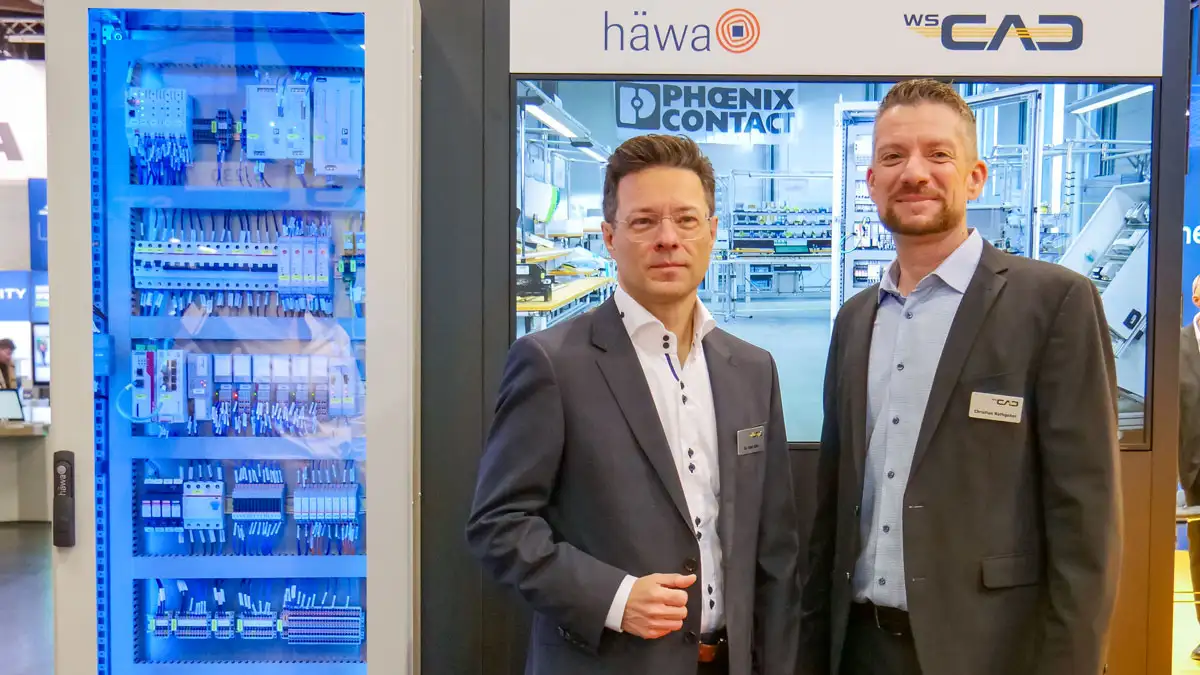
Dr Axel Zein (CEO, WSCAD GmbH) and Christian Rathgeber (Team Lead Business Development, WSCAD GmbH) presented the first AI-generated control cabinet at SPS 2025.
This article is intended for your personal use only. Reproduction or publication requires the express written consent of the publisher.