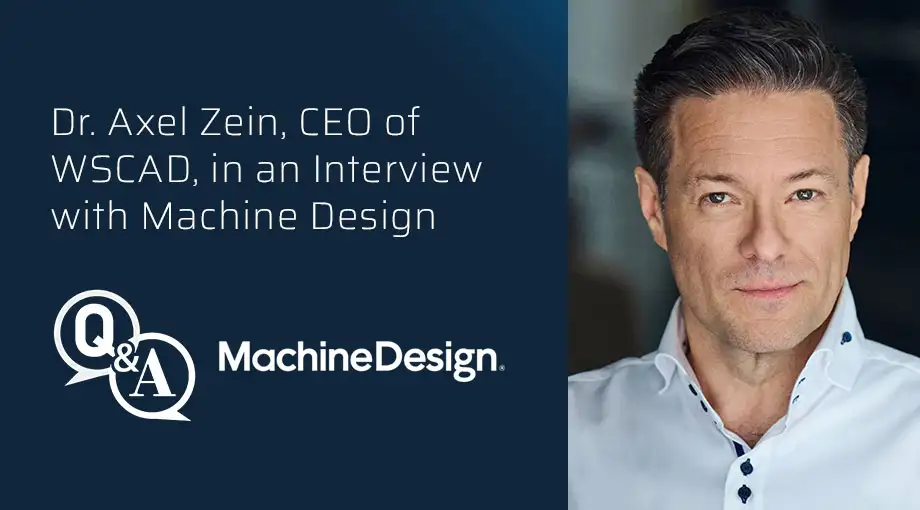
Based on an interview with WSCAD CEO Dr. Axel Zein in Machine Design (August 10, 2026)
Interview: (Machine Design)
Electrical CAD is moving from documenting engineering decisions to participating in them. In an interview with the U.S. trade magazine Machine Design, WSCAD CEO Dr. Axel Zein explains what AI-native engineering means in practice and why the hardest part of adopting it has very little to do with software.
The occasion for the conversation was the U.S. launch of ELECTRIX AI, positioned as the first AI-powered electrical CAD platform. The software supports U.S. electrical standards including NFPA 79, ships with IEEE 315 / ANSI Y32.2 symbol libraries, and allows projects to be designed in compliance with NFPA 70 (NEC) and UL 508A. But Zein, CEO of WSCAD GmbH and President of WSCAD Inc., used the launch to make a broader argument: that the value of AI in engineering is decided long before anyone opens a CAD tool. “Electrical engineers do not need more hype around AI – they need practical tools that help them get real work done faster,” he says.
Competitive advantage does not come from tools; it comes from evolving the roles of humans to embrace new ways of working that create value for the business.
Dr. Axel Zein, WSCAD
Where the Competitive Advantage Actually Comes From
In Zein’s view, the first returns from AI show up as time and labor savings. In electrical engineering specifically, he expects the technology to change the role of designers and engineers: fewer low-value tasks, higher quality, and more time for ideation and iteration. What he is careful not to do is locate the advantage in the software itself. Tools, he argues, are available to everyone; the advantage lies in how organizations let the work change around them.
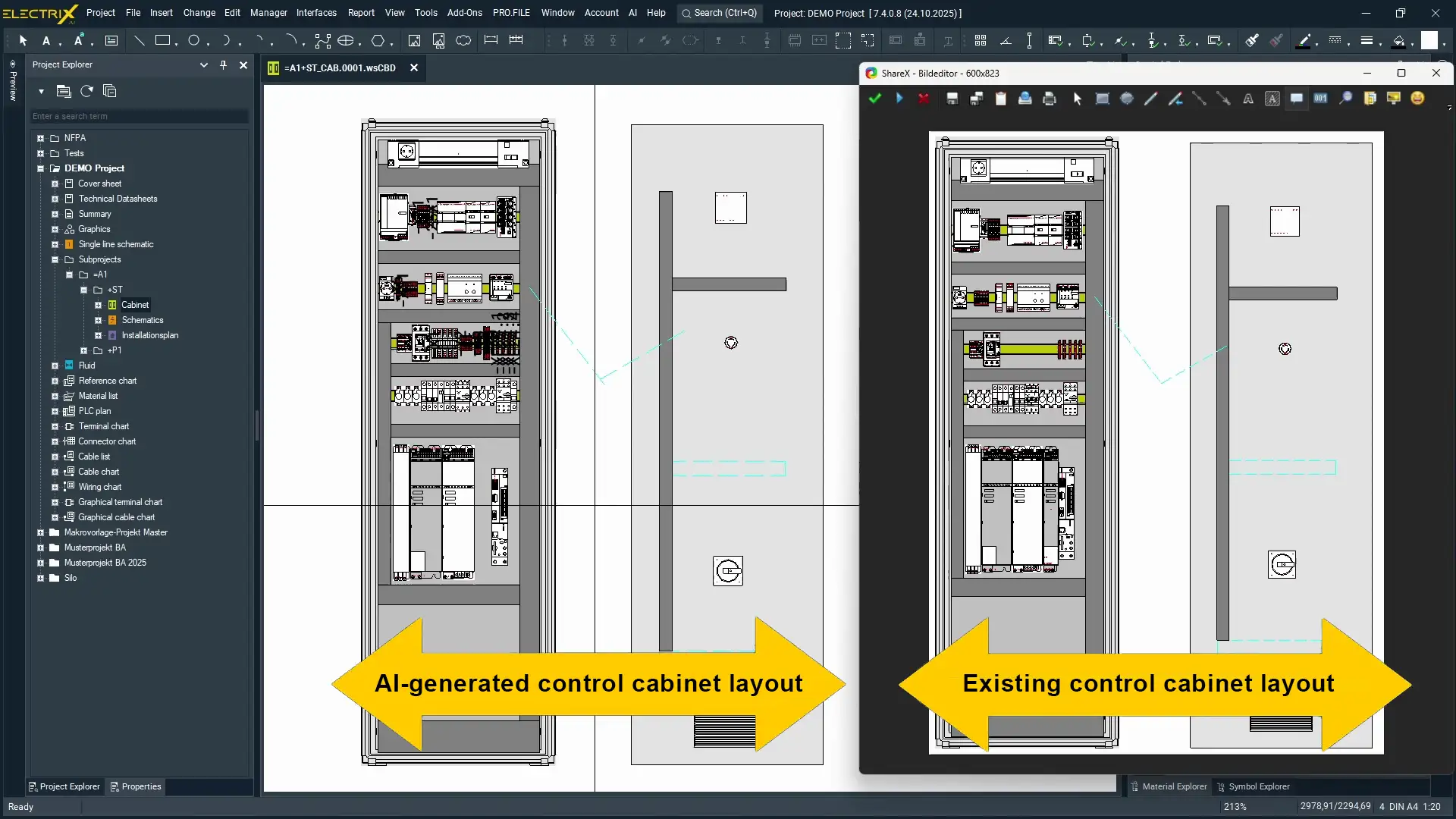
ELECTRIX AI generates complete control cabinet layouts directly from the schematic.
What AI-Native Engineering Means
The distinction Zein draws between AI-native systems and conventional CAD with added AI features is a distinction about who does the engineering. Traditional CAD helps engineers design and document products before they are built, but the engineering itself still happens in the engineer’s head and is then translated into the system. “AI-native systems take over parts of the actual engineering work,” he says. Or, as he puts it, it is the difference between drawing the product you engineered in CAD and defining the product and having the system generate the design.
Why Electrical CAD Still Falls Short
“Most electrical CAD systems are still documentation-centric rather than engineering-centric,” Zein says. They produce excellent schematics without understanding the engineering intent behind them, which is why engineers designing electromechanical machines still bridge the gaps between electrical logic, mechanical constraints, control behavior and manufacturing realities by hand. The friction between mechanical and electrical CAD has the same root: “Mechanical CAD is geometry-driven while electrical CAD is logic- and connectivity-driven.” Teams exchange files, he notes, but not true engineering intent – a gap that no integration layer closes, because it requires a common engineering model across domains. The tasks that resisted automation longest are the ones built on judgment rather than drafting: system architecture, control logic, cost versus manufacturability, exceptions. “Traditional automation depends on fixed rules. Engineering rarely does.”
AI is not a tooling issue. It is a leadership and organizational issue.
Dr. Axel Zein, WSCAD
Where the Gains Are Measurable Today
The productivity Zein describes is not speculative. Macro generation and reuse, cabinet layout generation, terminal lists and bills of materials are already being produced with far less manual effort – and by a far broader range of users than those with deep CAD expertise. ELECTRIX AI generates control cabinet designs from the schematic using WSCAD’s own models, developed together with panel builder customers: “What used to take days is now done in minutes.” Automated project translation covers 102 languages, and compliance checks that once meant reading through endless pages of customer specifications now run in seconds against an uploaded requirements document. WAGO, a WSCAD customer, reports that ELECTRIX AI shortened its engineering effort by 50%. Zein’s benchmark is deliberately blunt: AI has to produce measurable engineering productivity gains, not impressive demos.
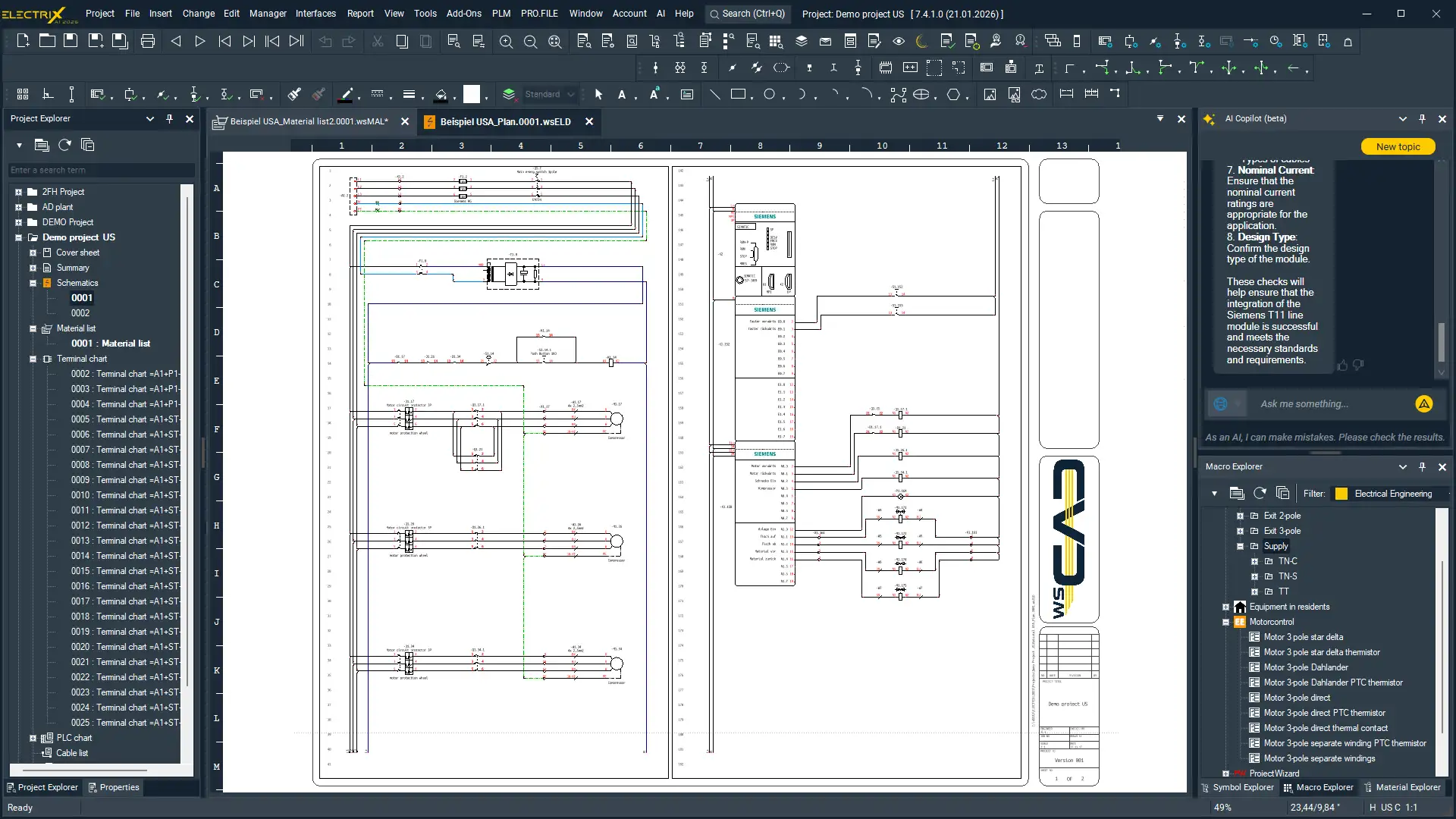
WSCAD is introducing ELECTRIX AI to the U.S. market, with NFPA 79 support and IEEE 315 / ANSI Y32.2 symbol libraries built in.
The Barrier Is Leadership, Not Software
The most common failure Zein sees has nothing to do with models or licences. “The biggest mistake is treating AI like an IT project,” he says – and companies that miss this stay stuck in permanent experimentation. His advice to mid-sized companies is to start somewhere other than the technology: identify where decisions are being made today that could be systematized, and the highest-leverage use cases become obvious. The same split shows up between teams. “The best teams are the ones that adapt fastest,” Zein says, pointing to continuous learning, cross-disciplinary collaboration and a willingness to change the process itself. Struggling teams, by contrast, try to preserve existing workflows and bolt AI on top.
From Drawing Tool to Engineering Partner
Where does that leave electrical CAD? Zein expects it to become a decision-support system. Historically, these tools documented decisions engineers had already made; the next generation participates in making them – suggesting architectures, flagging design risks, optimizing cabinet layouts, validating manufacturability and catching inconsistencies before they turn into expensive downstream problems. Engineers keep responsibility for the final call, but “the software becomes an active engineering partner instead of a passive drawing tool.” For the U.S. market, Zein sees the opening less in AI alone than in productivity and simplicity: mid-sized machine builders, panel builders and system integrators who find enterprise platforms increasingly complex and expensive to maintain, and who judge software by how quickly their engineering teams can deliver projects.
This article summarizes an interview with Dr. Axel Zein first published by Machine Design on August 10, 2026. All quotations are taken from that interview.