Interview with WSCAD CEO Dr Axel Zein for the German ELEKTRONIKPRAXIS magazine (December 2025)
Author: (Editor, ELEKTRONIKPRAXIS / Vogel Communications Group) (Translated from German)
WSCAD is using artificial intelligence to enable its electrical CAD software to design entire control cabinets automatically. The AI model plans mounting plates, DIN rails and devices. Interestingly, many competitors remain passive in this area. In the interview, Managing Director Dr Axel Zein explains what this means for electrical designers.
WSCAD’s electrical CAD system supports electrical designers in the design and documentation of machines and systems. At the SPS (the annually world’s leading trade fair for smart and digital automation, in Nuremberg, Germany), the company is presenting a new generation of AI that automatically generates a complete control cabinet design from a circuit diagram. Dr Axel Zein, Managing Director of WSCAD, speaks with ELEKTRONIKPRAXIS at the SPS about its AI model without cloud dependency, PDF import as circuit diagrams, and why the role of the designer is enhanced rather than made redundant.
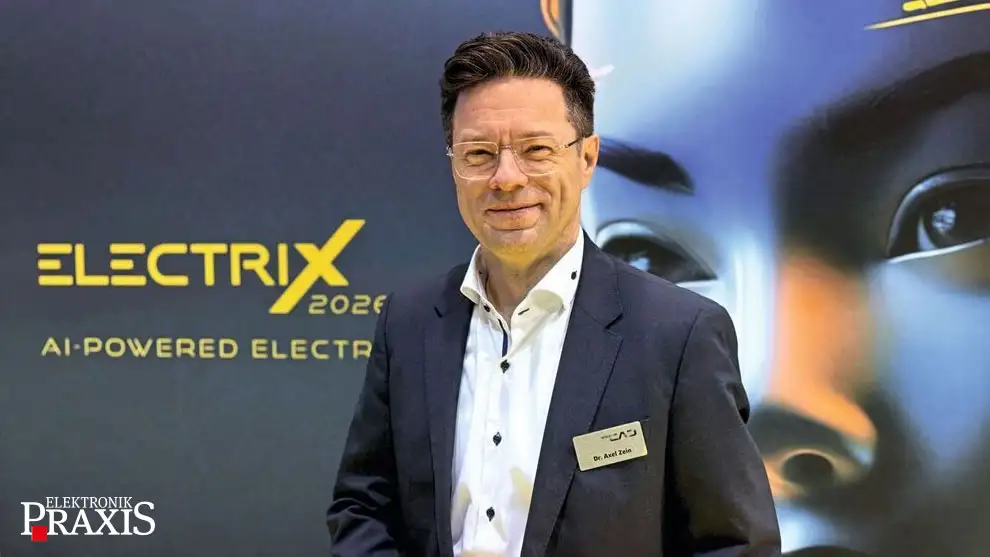
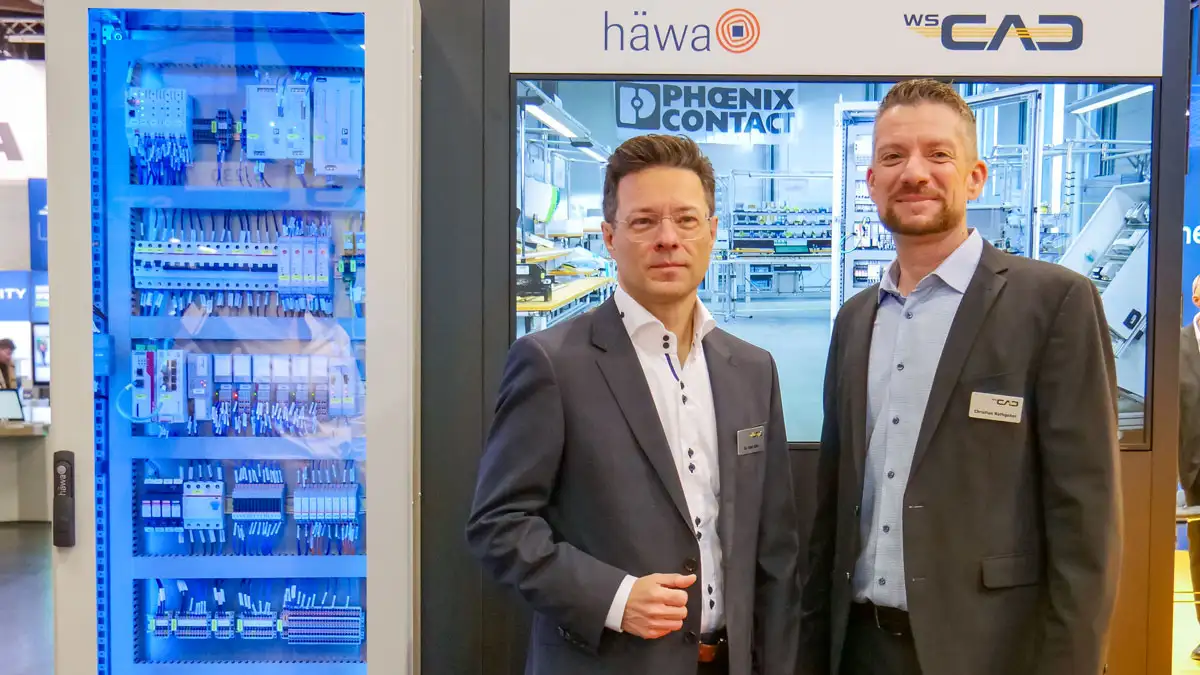
Dr Axel Zein, CEO of WSCAD: In the interview at the SPS trade fair, he explains how AI models automatically generate complete control cabinet designs from circuit diagrams. (Image: mc/VCG)
Your stand immediately attracts attention with AI-generated control cabinet design. What exactly are you showing, and how far along are you?
A. Zein: Last year, we were the first provider worldwide to present an electrical CAD solution with integrated AI, and at the SPS trade fair we are already showing the second generation. I am surprised that the market talks a lot about AI but delivers very little that is truly productive. Our users – traditional electrical designers in mechanical engineering – are already benefiting in practice from automation steps that cover the complete control cabinet design: recognising components, selecting mounting plates, placing DIN rails, positioning devices, and much more.
These processes are automated by our own models. The AI analyses the circuit diagram, interprets the technical content and generates the control cabinet design from it – including the ability to learn from customer projects. This massively reduces complexity and repetitive work.
You speak of your own AI model. Does that mean you are not relying on ChatGPT, Gemini and similar solutions?
A. Zein: Correct. In engineering, strict standards and clearly defined rules apply. “Approximately correct” is not sufficient. For automatic control cabinet design, we need a fully controllable model – otherwise there is a risk that external specifications or non-transparent model decisions will distort the result.
Generic cloud-based AI is excellent for language or knowledge tasks. But in engineering, relying on external, non-controllable models means becoming dependent on their roadmap, priorities and error rates. From our point of view, that is not a viable basis for safety-critical steps.
At the Hannover Messe (one of the world’s largest industrial trade fairs in Hannover, Germany), competitor Eplan announced AI support for control cabinet design. How do you assess this?
A. Zein: We are, of course, observing this. On the one hand, the concept presented there is based on a standard AI infrastructure from Microsoft/OpenAI. This raises fundamental questions: Where is the data stored? How can compliance with standards-relevant rules be ensured in a reproducible way? How can misinterpretations by a model that you neither own nor control be prevented?
On the other hand, the presented use case was, in my understanding, not an AI application. Automatically placing components from Excel lists is an automation function that our industry has known for decades. It is useful, but it is not artificial intelligence. The market expects genuine AI methods that fundamentally change engineering workflows. That is exactly what we are working on at WSCAD.
But your own product is already in productive use?
A. Zein: Yes. We have been productive at customer sites for around a year. The feedback is very clear: engineering time is being reduced – by 50% at WAGO, for example. And this is still based on our first generation of AI, not on the automatic control cabinet design that has now been presented.
The automatic control cabinet is a visible highlight. But the real added value comes from the large number of small, intelligent automations in everyday work. In some work steps, customers save more than 90 % of time with the help of artificial intelligence.
For example?
A. Zein: A large proportion of German machine builders export internationally. Circuit diagrams therefore have to be translated into many languages. Until now, this was a multi-day, error-prone process: copy and paste, translation agency, copy and paste again. Our solution translates into more than 100 languages at the push of a button – including technical terminology from the customer’s electrical CAD system. This takes about one minute and is carried out context-sensitively within the project. This function increases productivity immediately.
Does this translation AI reach the quality of a human translator?
A. Zein: Yes, because we also take technical terminology into account. Electrical engineering relies heavily on specialist terminology. In all electrical CAD systems, users can define their own lexicons.
When they deliver to English-speaking markets, most of the terms are already present in the system. We combine this with AI-based translation as a first step. In the second step, we enrich this with technical terms from other languages. For very rare languages, current models naturally reach their limits – but for our relevant target markets, it works reliably.
Is this translation AI the same one that designs the control cabinet?
A. Zein: No. We clearly separate by use case. Translation is based on language models enriched with our technical terminology – this is an established approach. The control cabinet agent, by contrast, is a proprietary WSCAD model that must work with high precision and determinism. This is where our competitive advantage lies.
You mentioned PDF import. What does that involve?
A. Zein: Many control cabinet manufacturers receive only PDFs, not the original electrical CAD data. These PDFs have to be painstakingly redrawn. This is unattractive work, but currently unavoidable.
Our AI model analyses the PDF, recognises symbols, connections, components and data, and automatically generates a complete WSCAD project from it. This saves a great deal of time and reduces sources of error. Incidentally, it also improves employee morale.
Does all of this run in the cloud or locally at the customer’s site?
A. Zein: The control cabinet agent runs entirely locally on the customer’s workstation. It learns from the customer’s projects – and this data remains with the customer. For engineering data, cloud processing is usually not acceptable. For text translation, however, the cloud is uncritical. That is why we use a hybrid approach there.
When will the second generation of your AI functions be available?
A. Zein: Delivery will start shortly, so this is a genuine innovation at the SPS trade fair. Everything we are showing here runs productively on the system. The software is surprisingly stable, which gives us great confidence. Existing customers will receive the new functions as an update within their subscription or maintenance contracts.
Why are you, in your view, currently the only provider with such comprehensive AI-based control cabinet automation?
A. Zein: We see two reasons. Electrical CAD is a highly specialised sector dominated by a few European manufacturers with strong legacy structures. We observe that Europe approaches AI more cautiously than the USA. WSCAD, however, was very early because we believe in the power of artificial intelligence.
Secondly, AI development is extremely dynamic and requires a high degree of agility. Large companies often move more slowly and cautiously. From our perspective, it is therefore no coincidence that we are taking a pioneering role here.
How strongly does your solution change the market? Are we talking about a game changer?
A. Zein: I believe so. The role of the designer is strengthened. Responsibility remains entirely with the human. The AI takes over monotonous, repetitive steps – the designer continues to make the technical decisions.
I compare the new role of the designer to that of a conductor: they orchestrate AI tools, control the process and maintain an overview. They move away from being a one-person orchestra who has to press every single key themselves. This leads to higher-quality results in less time. With us, you type “generate bill of materials” or “create the terminal list” in the chat, and the AI does it. The operation is so intuitive that it works even for beginners. Manual, repetitive steps are eliminated, and anyone who has experienced this new way of working no longer wants to return to the old process.
Customers use the freed-up capacity to take on more projects and to grow – not to reduce staff.
The term “agentic AI” is often mentioned in this context. Are you working in this direction?
A. Zein: Yes. Our control cabinet agent is essentially exactly that: an agent that independently executes a classic workflow based on our own models.
In the long term, the designer will upload technical requirements and the agent will generate the circuit diagram based on them – including targeted clarification questions. This will fundamentally change the way work is done.
You often compare this with automation in manufacturing. What lesson do you draw from that?
A. Zein: When manufacturing in the automotive industry, for example, was automated decades ago, people said: “Jobs will be lost.” The opposite happened. Sub-processes were automated, output increased, more people were hired and more cars were produced. Today, hardly anyone in manufacturing works manually with a cordless screwdriver – robots do that. But people are needed to operate the robots.
The same will happen in electrical design: jobs will be transformed to a higher level. No one in electrical design will miss the 20 clicks needed to create a terminal list or a bill of materials. These tasks will be shifted to the AI and completed instantly, while humans control the system. And when productivity increases, every entrepreneur says: “Great, now we do more business.” More business always means more employment, sometimes in different roles.
You mentioned that you developed control cabinet automation with a customer. Who exactly?
A. Zein: We are developing control cabinet automation, among others, together with Baader Schaltschrankbau from Augsburg – a company with very heterogeneous customer projects. This is precisely where extremely practical requirements arise, such as the PDF-to-circuit-diagram workflow. This customer-centric development massively increases the relevance of our AI.
Your system has been on the market for around a year. Are you already seeing effects on market share?
A. Zein: We are seeing a significant boost particularly in the US: those who use AI in engineering accelerate their business immediately. In Germany, entry is often still accompanied by concerns. But as soon as customers see a demo and realise how much time can be saved and how easy it is to use, the mood changes very quickly. The momentum is growing, and we are very well positioned technologically.
Has the mood changed since the last SPS trade fair?
A. Zein: Yes, noticeably. AI has moved from a fringe topic to the mainstream. This helps enormously: we have to explain fewer basics and can talk directly about concrete processes. The industry recognises that our AI technology is suitable for practical use and that it is worth getting involved early.