
The Frankfurt Airport Case Study
The Problem:
Massive inefficiency maintaining 20,000+ electrical plants due to fragmented data and incompatible CAD systems from various suppliers.
The WSCAD Solution:
Scalable engineering with 90,000+ data points seamlessly connected in one single, standardized software platform for error-free live docs.
Digital precision through WSCAD software for one of Europe’s largest infrastructure projects
For the large-scale Terminal 3 project at Frankfurt Airport, Fraport Ausbau Süd GmbH relies on a high-performance solution for building and room automation to manage the technical requirements of around 1,500 rooms and 240 networked controllers. With WSCAD Building Automation, not only are 150,000 automation functions managed with precision, but BACnet object-related function lists in accordance with VDI 3814 as well as complex structuring systems based on IEC 81346 are also implemented reliably. The automated generation of data point keys and the open database structure enable efficient collaboration without data discontinuity, ensuring that the energy-efficient terminal project remains securely on schedule.
At a Glance
Customer
- Fraport Ausbau Süd GmbH
- 100% subsidiary of FRAport AG, the operating company of Frankfurt Airport
- Commissioned with the construction of Frankfurt Airport’s Terminal 3
- terminal3.frankfurt-airport.com
Situation
- Designing the complete building and room automation for Terminal 3 at Frankfurt Airport: 1,500 rooms, 240 controls, 150,000 automation functions
- Selection and purchase of CAE design tools for integrated building automation
Benefits
- Activities performed faster due to an intuitive user interface and easy handling
- Designing “hand in hand” with service provider CANZLER GmbH without any data breaks, errors and time delays
- Easy implementation of BACnet object-related function lists according to VDI 3814
- Allocation of higher-level structure identifiers according to IEC 81346
WSCAD disciplines and add-ons used:

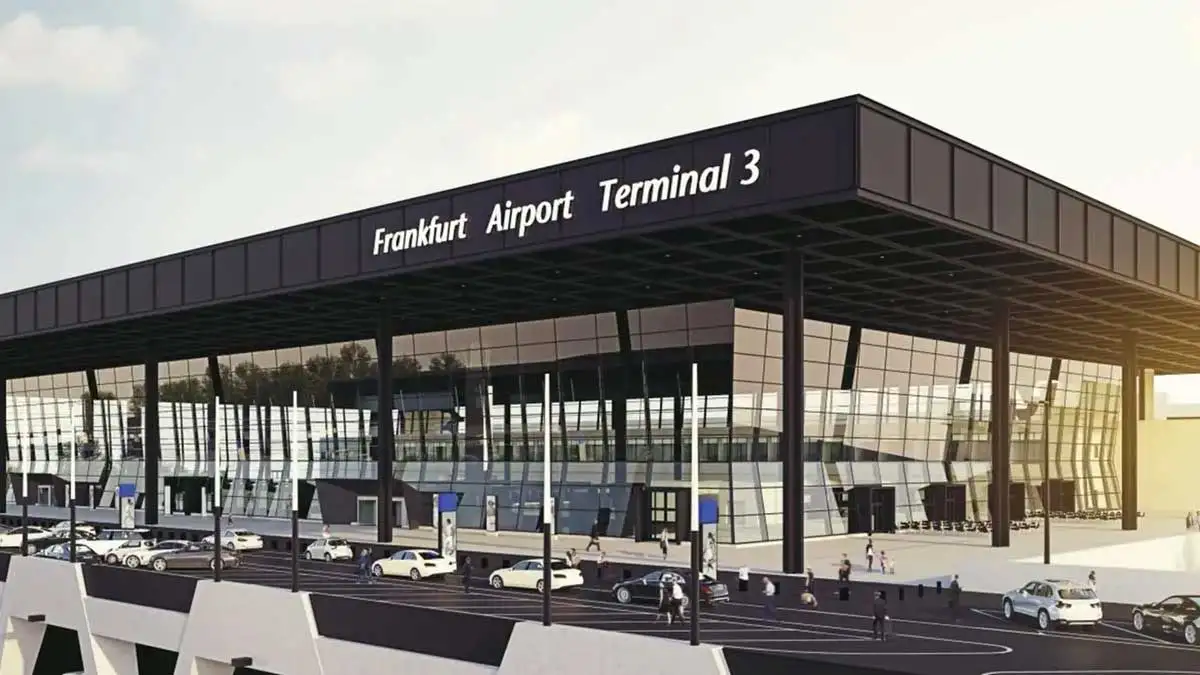
In its first expansion stage, the new Terminal 3 at Frankfurt Airport includes the main terminal building with the check-in areas, the central security control, a marketplace (shopping area / commercial zone) for travelers, the arrival and departure areas as well as transfer zones and baggage control centers. In addition to that, there are two pier annexes (Pier H and J) with associated gates and passenger boarding bridges and integrated bus stops for the shuttle buses. Depending on the requirements, this new terminal is expected to go into operation in 2026. Once fully expanded, the total area of 403,000 square meters will be distributed over five upper and two lower floors with a total of four gates and is designed to handle 25 million additional travelers a year.
The engineering design for the new terminal building, including technical equipment, tendering, and site supervision for the building automation system, is the responsibility of Fraport Ausbau Süd GmbH. “Airports are complex, highly engineered special-purpose buildings that require a specialised design methodology”, says Uwe Eckardt, Building Automation Design Coordination, Fraport Ausbau Süd GmbH.
In order to avoid data discontinuity, errors and delays, we have followed a holistic design for building and room automation from the beginning.
The engineering company CANZLER GmbH is one of the most important service providers and is already involved in the design phase. 150 employees at eight locations in Germany, are advising customers in the strategic development and implementation of workplace concepts across multiple locations. Engineers, architects, facility management and real estate consultants are working together on complex tasks for consulting, design and management. The mission for CANZLER within the Terminal 3 megaproject encompasses the design of building automation, air conditioning, heating, ventilation and sanitary engineering as well as the support of the operator Fraport during the tendering process. Our design allows for a flexible utilization in later operations”, says Heike Frommhold, Project Manager Building Automation at CANZLER, and continues: “Flexible utilization requires a wide range of technical requirements, that have to be harmonized efficiently.” For example: retail spaces need more cooling capacity, passenger areas with fluctuating number of customers need comfortable room conditions independent of climatic conditions.
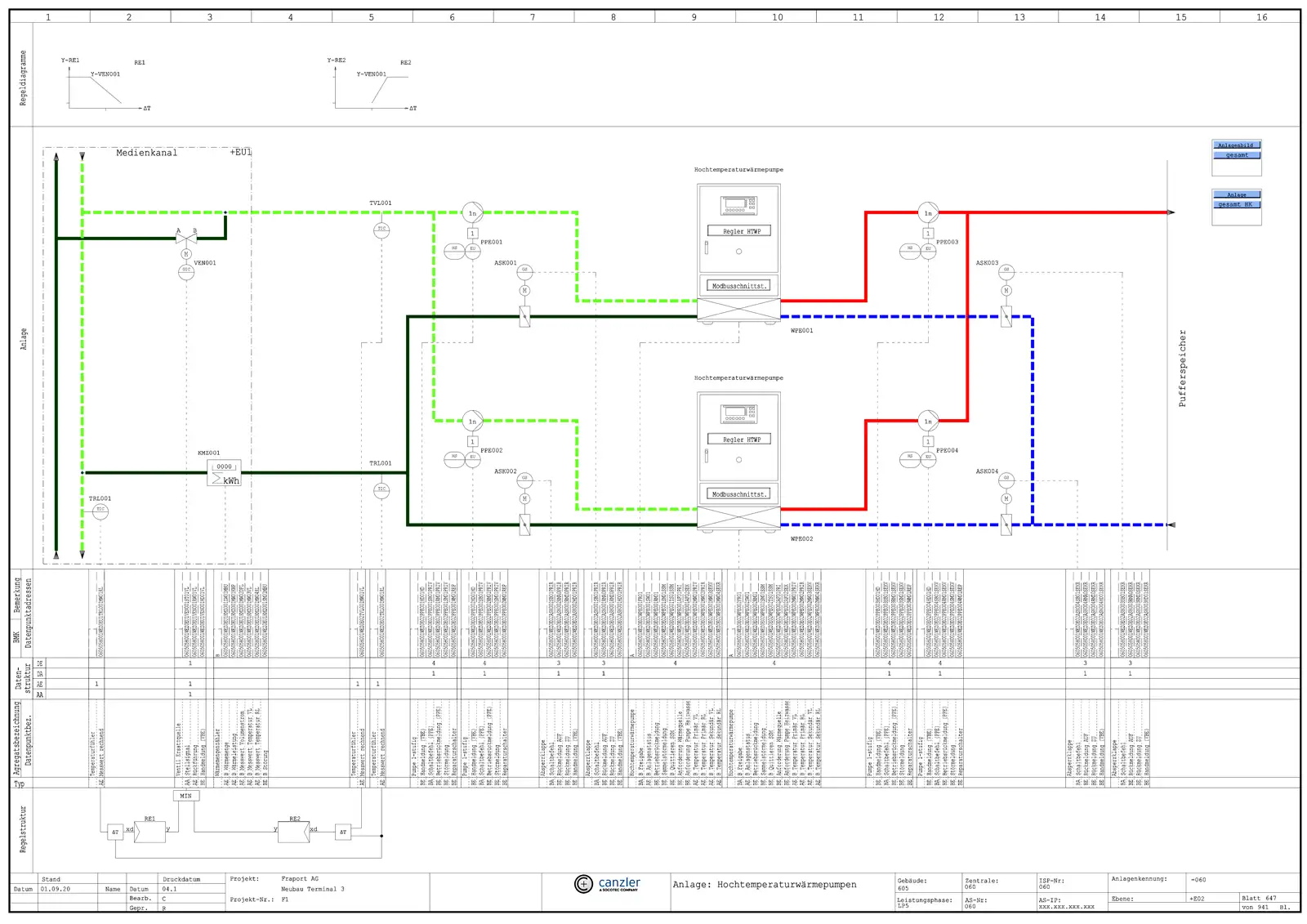
The automation schemes for the heat pumps for Terminal 3 at the airport Frankfurt were developed at CANZLER with the Module BA of the electrical CAD solution from WSCAD. Among the advantages of this solution is the higher-level structuring according to IEC 81346.
Fraport demands an energetically sustainable building. So for example waste heat from the baggage conveyor system will be used to heat the terminals.
Following extensive market research before the start of the project, specialists at Fraport decided to use the electrical CAD solution from WSCAD for the technical design of the building and room automation. Both, client and service provider are using the building automation software from WSCAD. They design plant and automation diagrams, lists of functions according to VDI 3814 and bills of materials. “BACnet object-related lists according to VDI 3814 can be implemented perfectly with WSCAD”, says Uwe Eckardt. “We have been working with WSCAD for about 10 years now. At the time it was the only software that had the performance characteristics required by Fraport.” User identification of the data points are given according to the Fraport sample scheme – those, in turn, were individually developed by CANZLER. The scope of work includes: the automatic control of heating, air conditioning and cooling systems, the monitoring of plumbing and sprinkler systems, room automation control of approximately 1,500 rooms and the smoke (purge) control of the whole terminal. The 240 controls, along with components, are mounted in control cabinets that are cross-linked within the building with under two to five fields. 80 of these cabinets alone are designed for the smoke extraction system. “The system includes around 90,000 data points and 150,000 automation functions, including 23,000 security-related functions, that are implemented via redundant controls”, says Heike Frommhold from CANZLER. “At the request of our client we have been using WSCAD for the design since 2012”, states Heike Frommhold. “We didn’t know this building automation software, but we came to appreciate it, because of the short training period needed to work fast and effectively with it”.
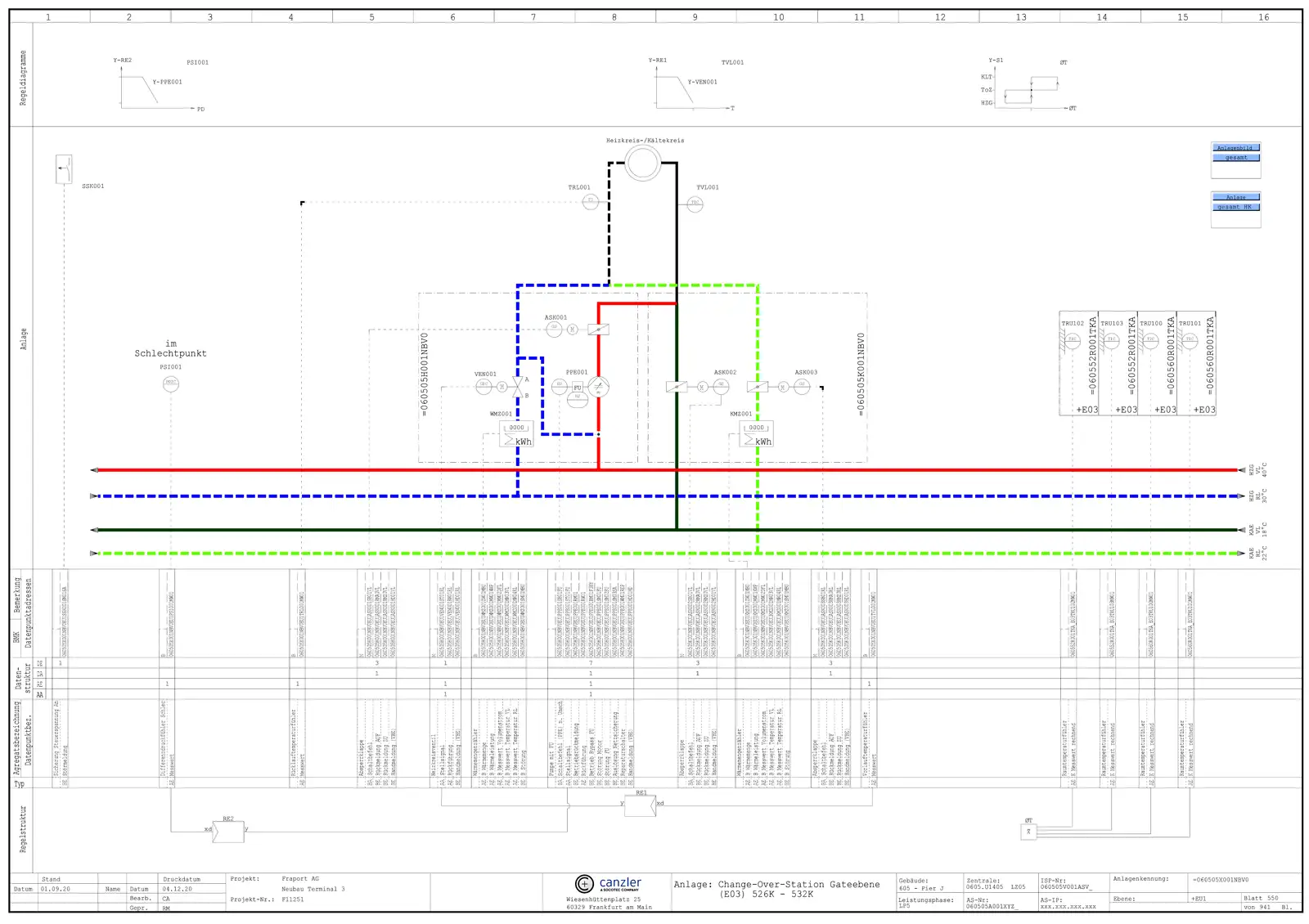
Over 90,000 data points and 150,000 automation functions for Terminal 3 at Frankfurt Airport were created using the Building Automation module from WSCAD. They were linked for instance to the system diagram of the change-over stations.
We appreciate the automatic generation of data point keys and the option to quickly and easily modify them afterwards.
For Uwe Eckardt from Fraport Ausbau Süd GmbH the structure identifiers are among the highlights and outstanding characteristics of the project: “For us a particularly convenient feature of the WSCAD solution is the option to use structure identifiers according to IEC 81346. The possibility to use structure identifiers makes it easy to define subsystems for example a cooling system, and handle it separately as part of a higher-level air conditioning system.
A consistently well-thought-out structuring of systems from the start, accelerates and simplifies the design and development process enormously. Based on the aspects of location and function the structuring can be set up at any level and depth. For example: let us assume that a specific drive of a ventilation system consisting of a motor, fuse protection and control is used in another area of the building. The only thing we need to do is to drag & drop the macro of the drive into the new design. All identifiers are automatically taken over and inserted into the new structure. A correct structure enables us, to generate the cable pull and parameter lists for specific building components, according to design and parts data. Time consuming and error-prone manual renaming is omitted – one advantage that cannot be dismissed when considering approximately 200 built-in ventilation systems. The fixed system key, developed for this project, includes user address and data point and consists of a total of 31 positions. Even when it is necessary to rely on existing system keys, the automated generation of data point keys is possible in WSCAD. The software will automatically update the system keys for all data points during changes.
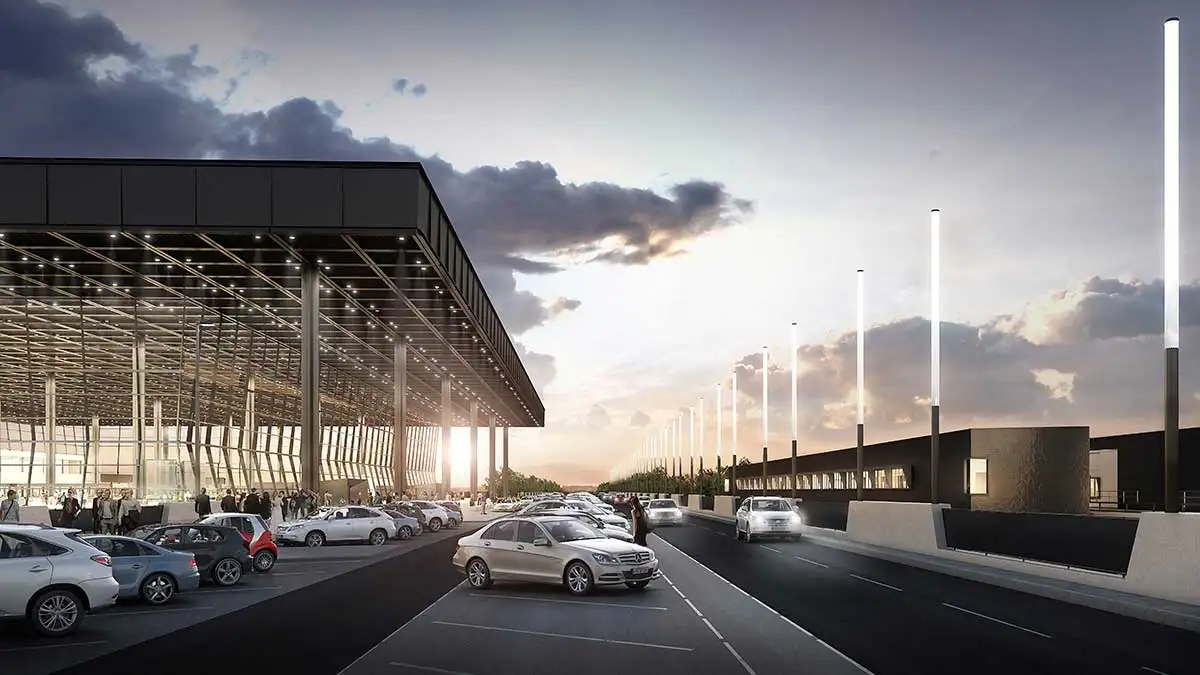
The arrival and departure area of the new Terminal 3 at Frankfurt Airport, with a Passenger Transport System (PTS) station in the background.
The definition of high-level structure identifiers according to IEC 81346 is very convenient – it enables us to autonomously design the cooling system as a part of the (higher-ranking) air conditioning system.
Fraport and CANZLER are emphasizing additional advantages of the WSCAD software solution: the supplied plugins for data point keys and the extensive symbol library required for designing BA-projects. In addition, the underlying database is popular with the designers: it is openly accessible, which enables and simplifies the export of all project data. One can easily create project specific and customized part databases.
The next step is the award of contracts to the building automation trade. A Fraport data point library will be created in which the required functionalities from the Fraport BA specifications are clearly described and specified. At the same time, locally stored priority controls can be assigned to individual objects. This database will be passed on to the external BA designers, so that they all have the same base to work from. The goal is to quickly ensure compliance with the required standards and a higher quality. “We still have a lot to do”, says Eckardt, “but thanks to WSCAD we are in time and on a good path.”
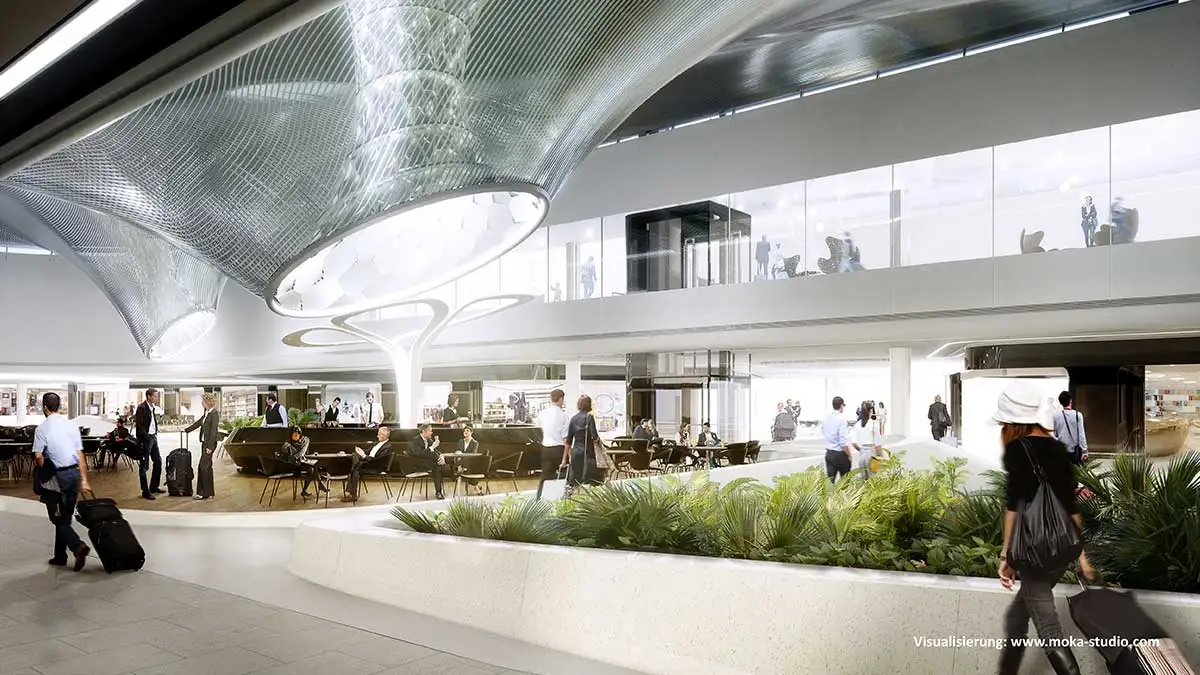
This is what the commercial area of the new Terminal 3 at Frankfurt Airport is going to look like. The building automation will be designed using the electrical CAD solution from WSCAD.
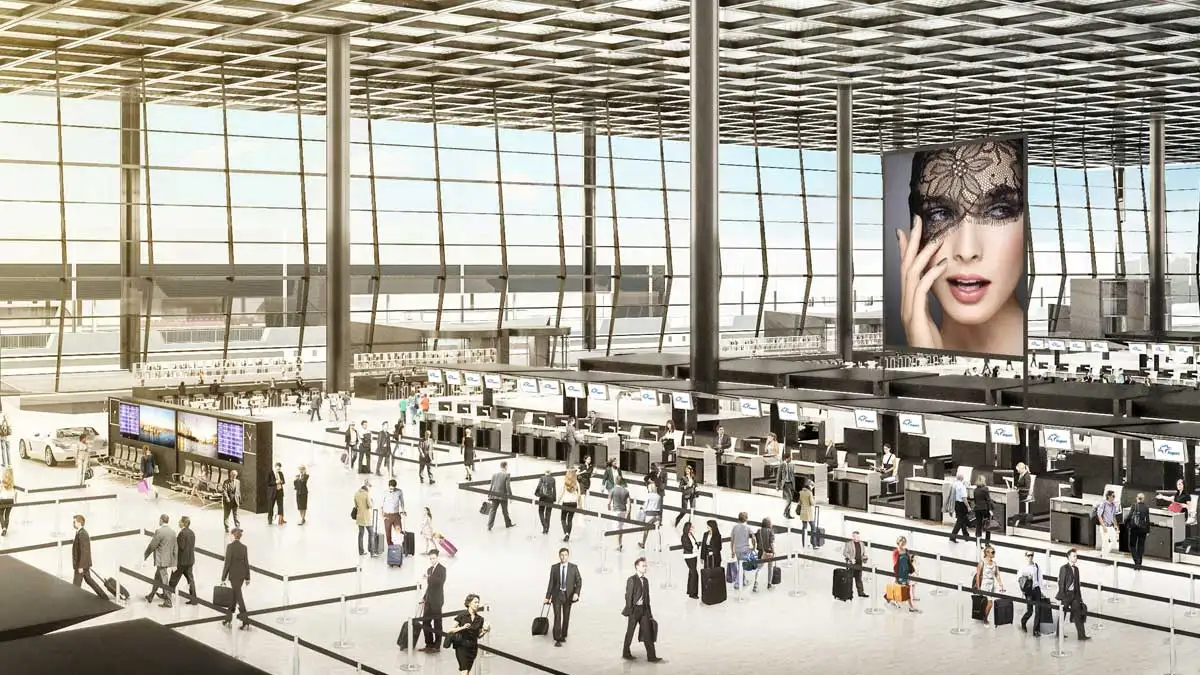
The design of the building and room automation for the check-in hall in the new Terminal 3 at Frankfurt Airport is done with the electrical CAD solution from WSCAD.
Download case study
This case study is intended exclusively for your personal use. Any reproduction or publication requires our express written consent.


