World premiere in electrical engineering: WSCAD introduces ELECTRIX OS, bringing Engineering Intelligence to market for the first time
ELECTRIX OS is the first AI-native engineering software platform by WSCAD: It understands engineering objectives, develops solutions and orchestrates subsequent engineering processes.
Bergkirchen, 13th October 2026 – WSCAD GmbH is introducing ELECTRIX OS, a new generation of engineering software that fundamentally changes the division of responsibilities between engineers and software. In what WSCAD calls the new category of “Engineering Intelligence”, AI takes on parts of the actual engineering work. Engineers define objectives, evaluate technical solutions and give final approval.
While conventional CAD systems primarily serve design and documentation purposes, and AI copilots support individual tasks, ELECTRIX OS intervenes earlier, at the stage where technical solutions are developed. The platform interprets requirements, takes technical constraints into account and draws on existing engineering knowledge. Engineers oversee the planning process, while the E-CAD system subsequently handles detailed design and documentation.
Key facts at a glance
- From drawing to decision-making: ELECTRIX OS takes over parts of the technical planning process before implementation begins in the CAD system.
- Additional engineering capacity: The platform develops electrical engineering designs based on requirements, standards and company guidelines. Engineers evaluate, modify and approve the proposed solutions.
- Making engineering knowledge scalable: Proven solutions and company standards can be reused in new projects. Technical decisions remain traceable.
CAD digitalised drawing. Engineering Intelligence is beginning to digitalise engineering itself. For decades, we have developed software that enables engineers to document their technical decisions. With ELECTRIX OS, this relationship is fundamentally changing: Humans define the objective, AI develops technical solutions, and the CAD system handles implementation and documentation. Engineers are increasingly evolving from those who carry out tasks into decision-makers and orchestrators.
Dr Axel Zein, CEO of WSCAD GmbH
WSCAD’s study, “The State of Electrical Engineering 2026”, highlights the need to ease engineers’ workloads. Among the 1,267 E-CAD users surveyed across 40 countries, around 54 per cent said they had no time for innovation or improvements to their workflows.
From technical requirements to a complete design
ELECTRIX OS is built on an AI-native architecture in which an intelligent engineering layer interprets technical requirements, develops solutions and controls their implementation through downstream CAD systems.
Engineers assign ELECTRIX OS a planning task and define the objectives and technical specifications. These may be based on specifications documents, customer requirements, company standards or task descriptions. The system breaks them down into verifiable requirements and documents their origins. If information is missing or specifications conflict, it asks clarifying questions and can suggest answers based on company standards or previous projects. Affected planning steps remain unresolved until these issues have been clarified.
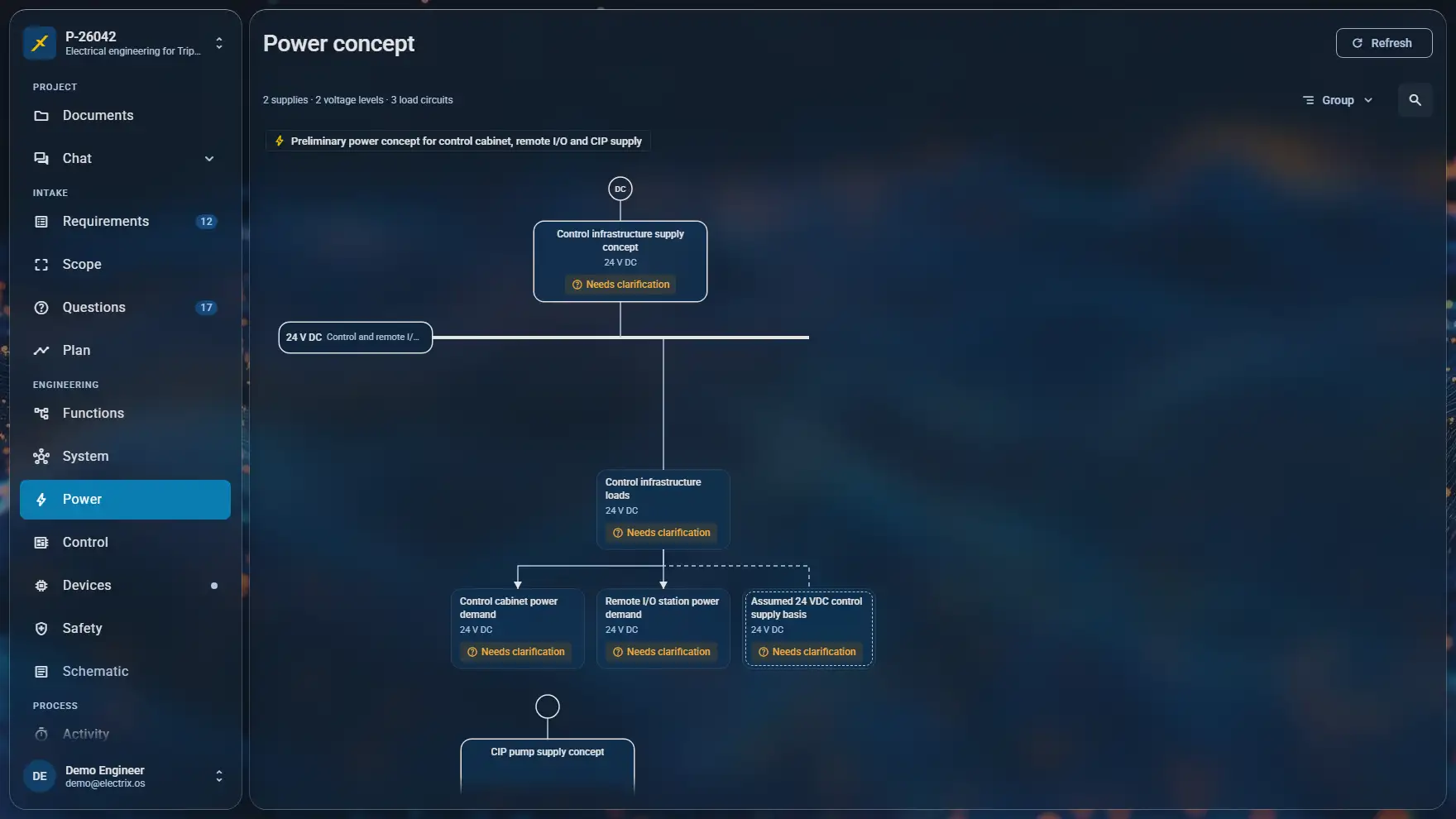
Based on technical requirements, ELECTRIX OS develops a structured power concept with voltage levels and load groups. Points requiring further clarification are highlighted directly in the design. (Source: WSCAD)
One potential application is the electrical engineering design of a packaging machine. The engineer specifies a production capacity of 250 bottles per minute, the use of Allen-Bradley components, relevant UL requirements, redundant safety circuits and a maximum control cabinet width of 50 inches. ELECTRIX OS uses these parameters to develop a design – from the functional structure and power distribution to control and safety concepts and component selection. The engineer evaluates alternatives, requests modifications and approves the solution.
The platform then uses the E-CAD system to generate the required circuit diagrams, bills of materials and manufacturing documentation. Initially, integration will be provided through WSCAD’s own E-CAD software, ELECTRIX AI.
Trustworthy AI rather than maximum autonomy
Technical decisions in engineering must be traceable and verifiable against defined requirements, standards and design rules. ELECTRIX OS therefore combines specialised AI agents with a structured engineering model and fixed validation rules.
The agents perform different tasks, such as analysing requirements or developing power distribution, control and safety concepts. Before their proposals are incorporated into the project model, the system checks them for structural integrity, completeness and inconsistencies. Every AI processing step is logged, including its inputs and results. When changes are made, engineers can selectively revise the parts of the design that depend on them, reducing the effort required for modifications.
We have not simply put a language model in front of a CAD system. We have built a model of electrical engineering in which the AI can operate but does not define what is correct. Every proposal must pass the same validation rules that apply to human input. And where the AI is uncertain, it asks rather than decides. That is the difference between an assistant and a foundation.
Daniel Papp, Product Owner ELECTRIX OS at WSCAD
Preserving engineering expertise for future projects
A key element of ELECTRIX OS is its ability to connect technical requirements with a company’s existing engineering knowledge. The platform links requirements, assumptions, functions and technical objects within a shared project model. This makes it possible to trace why a particular technical solution was chosen and understand the impact of subsequent changes.
A separate knowledge base contains standards, company guidelines and proven solution patterns. The AI can apply this knowledge but cannot modify it independently. Solutions developed for one project can also be used in future projects, ensuring that accumulated expertise remains available beyond individual projects and when employees leave or change roles. Less experienced engineers can draw on their organisation’s documented knowledge and proven solutions.
The underlying engineering knowledge can be stored on a company’s own computers or servers; processing data in a public or external cloud is not required.
Development partners sought ahead of 2027 market launch
Ahead of the planned market launch in 2027, companies can help shape ELECTRIX OS by becoming development partners. They will work alongside WSCAD’s development team on their own projects and contribute their requirements to the platform’s ongoing development. Further information is available at www.wscad.com/en/electrixos/.
About WSCAD GmbH
WSCAD is the world’s first provider of AI-powered E-CAD software and has specialised in electrical engineering solutions for more than 35 years. Its unified platform integrates six disciplines with a central database, spanning electrical engineering, control cabinet design and building automation. AI features increase efficiency, enable automation and make complex tasks accessible to less experienced users. More than 40,000 users in over 100 countries use WSCAD in machine and plant engineering and electrical installation. Applications such as Cabinet AR and Building AR support digital planning and service processes. The E-CAD data library wscaduniverse.com provides more than 2.2 million component records free of charge. The portfolio is complemented by eleven engineering services, ranging from engineering checks to training and data conversion. WSCAD is part of the Buhl Group.
Press contact
BETTERTRUST GmbH, Luisenstraße 40, 10117 Berlin, Germany, wscad@bettertrust.de