Efficient maintenance: Digital schematics and AI reduce downtime
At Rotkäppchen Sektkellerei in Freyburg, production is all about precision and uptime. On two lines, up to 600,000 bottles are filled daily – a process with virtually no tolerance for downtime. To ensure reliable operations and minimize revenue loss, faults must be pinpointed fast and outages kept short. Since plant documentation exists only in paper or PDF format, the maintenance team is digitizing supplier-provided schematics step-by-step using WSCAD’s electrical CAD solution, laying the foundation for fast, modern maintenance workflows.
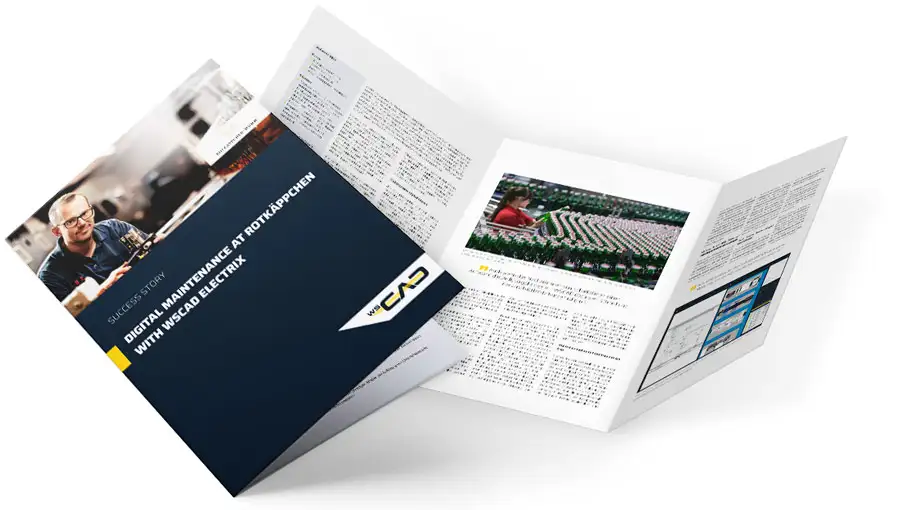
At a Glance
Customer
- Rotkäppchen-Mumm Sektkellereien GmbH, Freyburg (Unstrut), Germany
- www.rotkaeppchen-mumm.de
Challenge
- Maintenance and rapid troubleshooting are key success factors in production
- Line documentation from suppliers is mostly in paper or basic PDF format
- For smaller projects, electrical schematics and control cabinet layouts are developed in-house
Software / Hardware Used
- WSCAD ELECTRIX with Electrical Engineering and Cabinet Engineering modules
Results / Benefits
- Faster redesigns and digitization of legacy documents thanks to intuitive software handling
- Quicker fault diagnosis and reliable maintenance via intelligent digital schematics
- Efficient in-house control cabinet design and production line modifications
WSCAD disciplines and add-ons used:


The filling lines operate nearly round-the-clock in three shifts – precisely, automatically and under tight timelines. When a component fails, the line stops. “Every minute counts,” says Jan Wiemann, Workshop Manager with over 20 years at Rotkäppchen. “Our goal is clear: get the line running again as quickly as possible.”
The filler lines come from a major OEM but are complemented with components from numerous specialty suppliers, like labeling machines, packaging units, or wire-hood assembly equipment. The result is a highly complex system with schematics from multiple suppliers, mostly in paper or PDF format. Faults occur mechanically – in labeling or packaging units – or electrically, such as failed sensors, 24V power supply issues, or electro-pneumatic valves. The team must quickly identify the faulty component and locate the issue. But with diagrams buried in paper binders or PDF files, that means time lost searching, flipping pages, and cross-referencing.

Production runs around the clock at Rotkäppchen Sektkellerei in Freyburg. Two lines fill up to 600,000 bottles daily – every minute of downtime counts.
Even though redrawing schematics takes effort, WSCAD makes it fast, and the resulting benefits are substantial.
Digitizing Electrical Schematics
“Documentation is our biggest bottleneck,” Wiemann notes. “Time slips away finding the right diagram – and downtime costs money.” To speed up maintenance, Wiemann’s team converts paper or PDF diagrams into digital schematics using WSCAD electrical CAD. The process is labor-intensive upfront, but the payoff is huge: components can now be clearly identified, cross-references clicked, and parts data viewed directly. Wiemann sums it up: “Intelligent PDFs let maintenance teams instantly access technical specs, manufacturer info, or spare part numbers. One click reveals the exact schematic page with all details – no more hunting through stacks of docs,“ Wiemann explains. This clickable navigation to associated schematics or system functions marks a key step toward fully connected maintenance.”
Beyond digitizing existing docs, the Freyburg team uses WSCAD’s Cabinet Engineering module to design and build smaller control cabinets in-house. Major main cabinets come from machine builders, but modifications and add-on controls are handled internally.
Wiemann and his team value WSCAD’s intuitive interface. Menus are clear, visualization is modern, and the extensive pre-loaded symbols and parts data for valve islands, PLCs, contactors, or motor protection switches save significant time. Need a missing part? “WSCAD is flexible. We can quickly create custom symbols and parts ourselves,” Wiemann says. “It keeps us independent and saves time.”
“Even though redrawing schematics takes effort, WSCAD makes it fast, and the resulting benefits are substantial,” he adds. The team also praises WSCAD’s sales and support, which is responsive and practical whenever questions arise.


With nearly 600,000 bottles daily, flawless operation of Rotkäppchen‘s two filler lines is a top production success driver.
Faster On-Site Support with Cabinet AR App
Progress shines through WSCAD’s included Cabinet AR App for iOS and Android. Technicians scan QR labels on components to instantly access via smartphone or tablet schematic pages, component data, manufacturer datasheets, and even 3D component views. Connections on the back of components can be inspected without disassembly. Spare part requests can be triggered directly in the app, and changes made on-site are automatically fed back into the documentation via redlining. The result is a living digital twin, always reflecting the real state of the equipment.
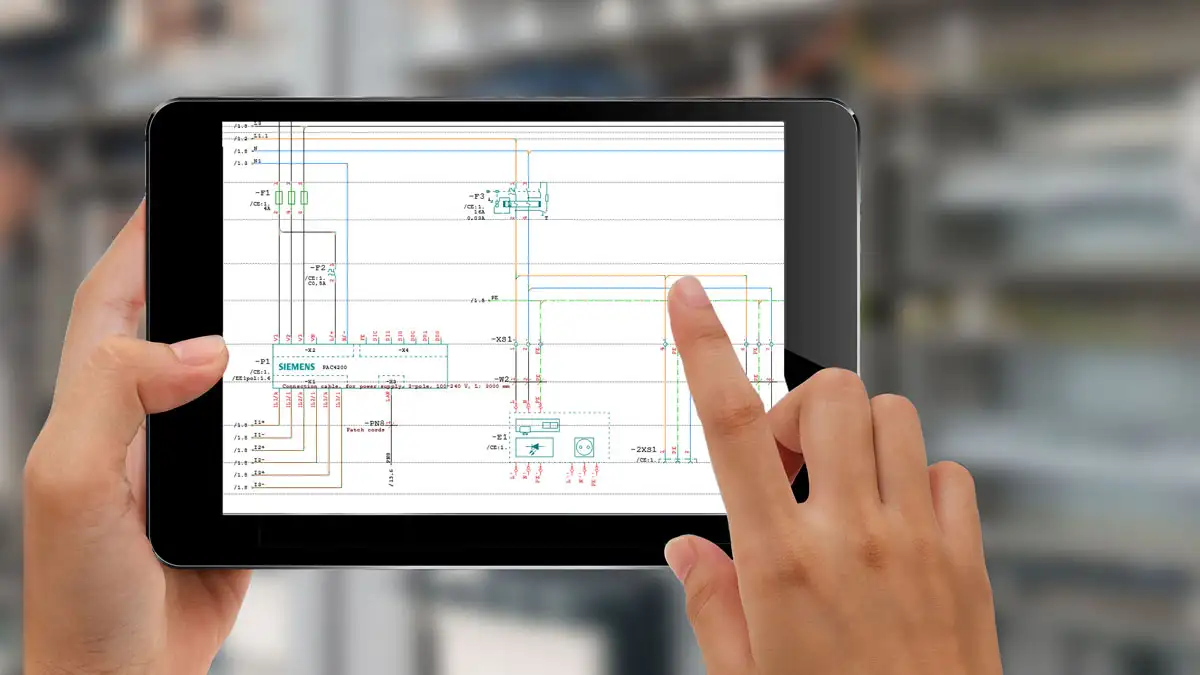
WSCAD‘s Cabinet AR App scan gives on-site techs instant access to schematics, part data, and OEM sheets. Direct spare requests and redlining keep docs live.
Next step: AI-Powered Schematics Import
The upcoming WSCAD ELECTRIX AI will further increase efficiency by automatically reading PDFs, DWG files, and scanned schematics, recognizing symbols, connections, and device identifiers – then generating intelligent, linked schematics in WSCAD. Resulting PDFs retain interactive navigation to other pages. “We’re looking forward to the day AI eliminates manual redrawing,” Wiemann notes. “It will save us a huge amount of time – time we need for line optimization and, most importantly, for troubleshooting.”
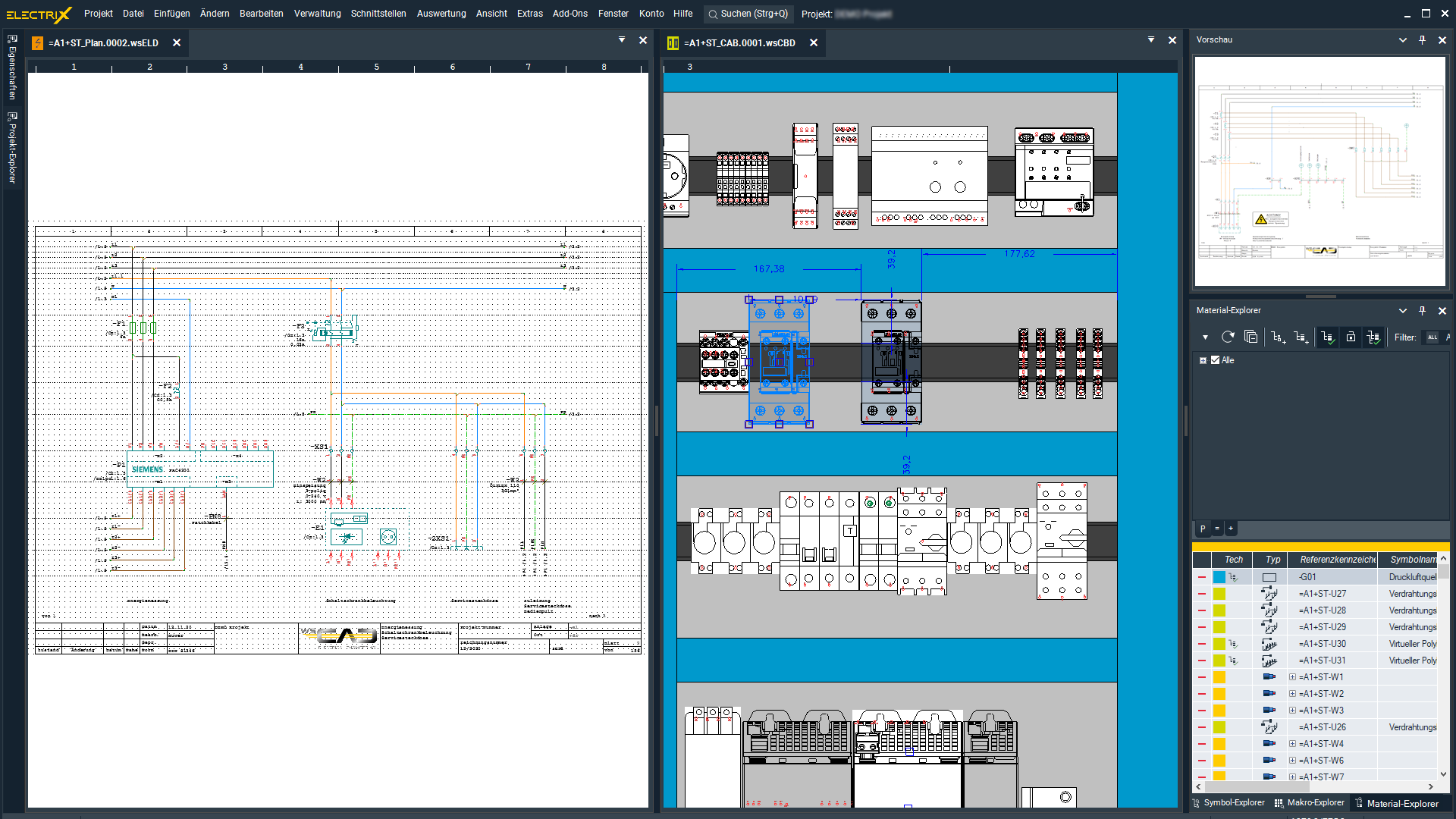
For add-on plant parts, techs create schematics and cabinet layouts using WSCAD‘s Electrical Engineering and Cabinet Engineering modules.
In the end, what matters is that the line keeps running – and with WSCAD, we have a tool that helps us do just that: quickly, easily, and reliably.
Conclusion: Faster Response, Less Downtime
Digitized schematics, AR support, and AI-assisted functions enable proactive maintenance at Rotkäppchen. Downtime is reduced, errors analyzed faster, and components replaced efficiently. Technical documentation remains up-to-date, delivering immediate benefits in daily operations.
“In the end, what matters is that the line keeps running,” Wiemann summarizes. “With WSCAD, we have a tool that helps us do just that – quickly, easily, and reliably.” Rotkäppchen’s maintenance demonstrates pragmatic digitization: no pilots, just practical improvements addressing real bottlenecks.

Smaller control cabinets and line components are designed and built by the Freyburg team independently, supported by WSCAD‘s electrical CAD software.
This case study is intended exclusively for your personal use. Any reproduction or publication requires our express written consent.